Collaboration:Build a Plan for Advocacy

In last week’s blog post, I outlined the scenario that has been unfolding in Vermont concerning proposed changes in the state statutes that describe school quality standards.  In the draft document, language about school libraries and staffing was eliminated, and a group of volunteers from the Vermont School Library Association (VSLA) has been collaborating to make sure that the language is reinserted.  So far, the action plan that was developed through the collective capacity of the group has been well received, and we are quite confident that our advocacy is on a successful track.

Here are a few ideas about collaborating for advocacy based on our experience:

  • Set group communication and actions-meetings face to face and virtual-Google docs, presentations, Skype, email, listserv.

Our group began meeting in late August, just as the school year was underway. Certainly, it was not a time for leisurely study of the issues, and we were aware that the Vermont Board of Education would be scheduling public hearings on the proposed changes in October. Our window of opportunity would be short.   Since we represented schools in both urban and rural areas from far corners of the state, we set up Google docs and used Skype when someone could not meet face to face.  TGFG-Thank goodness for Google!  After brainstorming a “to do” list, each person took responsibility for a piece of the action, and shared through our Google documents, presentations, and email.

  • Understand the issues, and the process, develop talking points.

Fortunately, the State Librarian was part of the group, and her contacts at the state level allowed us to move forward quickly.  The person who was the project coordinator for the revised document was very helpful in explaining the process so far, and also for helping us to understand that we still had an opportunity to suggest changes.  As a talking point, we developed a chart that compared the previous document to the proposed one. It clearly showed that all references to school libraries and library staffing had been eliminated. It included our suggested language to be reinserted, as well as, a rationale for school library programs, regionally and nationally.

  • Create a list of possible contacts, and supporters.

Brainstorming our own contacts, we came up with a list of possible people who might be in a position to help in advocacy planning.  We knew that we would need to alert our membership, but we wanted to have a clear message before we “called in the troops.”  We knew that we wanted the message to focus on the impact on students, not on our jobs.  We wanted to show what would happen if school library programs were not available for children all over the state.  Lots to think about!

  • Create a timeline of events, actions.

Through the State Librarian, we were able to schedule a meeting with the Secretary of Education, so that we could advocate for restoring language about school libraries and school library staffing to the Education Quality Standards.  After that meeting, we were assured that he would support our request with the State Board of Education during the review process.

On September 17, the president of VSLA, Denise Wentz, and I made a presentation at the monthly meeting of the State Board of Education.  Our focus was on the positive impact of school library programs in our state. See slide 22  for our concise talking points, “Why a School Library Program?”  https://docs.google.com/presentation/d/1RAY0bX0RwK1Ets1ky80DWH9KxftZADVcCZ7Ft8ZdTbc/edit#slide=id.g11a3c625c_2_42

Three public hearings will be held in October, and we are encouraging or members to bring supporters who will tell why school library programs are important to them.  Alternately, we are asking supporters to send letters or email to the Board during the public comment period.

  • Gather resources to support talking points.

Have your ducks lined up in one place that can be shared with all stakeholders. There are many resources available from a variety of organizations, experts, and bloggers.  In order to share the best of the best with our membership, we have gathered recommended “go to” sites, infographics, and documents that can be used to support school library advocacy.  We are happy to share them with everyone through this livebinders link: Advocacy for School Libraries  http://www.livebinders.com/play/play?id=1014077&backurl=/shelf/my

  •  Communicate with membership and other stakeholders.

Advocacy is an ongoing and organic process.  In VSLA, we will continue to focus on advocacy at all levels. It is not done by presenting at one meeting to administrators or school board members.  It is accomplished day to day with intentional purpose for making sure that the school library program is visible and essential for all learners.  Blogs, photos, newsletters, and websites are great vehicles for continuing to put a face on our programs.  Have a brand, have a mission, and don’t be afraid to shine.



Advocacy=Collaboration+Leadership

worldThe collective capacity of a group of like-minded folks is amazing.  In past posts, we have spoken about the benefits of belonging to professional organizations, at both the national and local levels, and I would like to share how the Vermont School Library Association (VSLA) has been responding to a situation that emerged recently.  Members of the organization are working together to make a difference and bring about change in a positive manner.  In a way, these actions have been a wake up call for all of us to understand the need for ongoing advocacy for school library programs.

A little background:

Since 2000, the Vermont State Statutes that define School Quality Standards have included language that describe staffing and school library resources. Throughout the state, school districts hired school librarians and supported school libraries as a result of the legislation. At the time that these standards were established, there was a school library media consultant at the Vermont Department of Education.  During reorganization in the early 2000’s, the position was eliminated.  Administrators and school librarians had guidelines, but no one to consult for questions that concerned school library programs.  The Vermont State Librarian who oversees public libraries took schools under her umbrella, and provided many resources that have continued to be helpful, and we have been fortunate to have that commitment and support.

Now:

In October 2012, a committee was formed by the Vermont Commissioner of Education and the State Board of Education to revise the School Quality Standards to update changes in educational policy that reflect current goals and practice-now called Education Quality Standards.   The members of the committee worked diligently for months to describe an educational system that meets the needs of today’s learners in Vermont.  School leadership, professional learning, curriculum and instruction, collaboration, and personalization of learning are detailed in the document, but with no one at the table to explain the school library program and its impact on all of these  topics, language about school libraries and the role of school librarians was eliminated from the document.

Enter VSLA.  While the process was unfolding, a group of members worked together on suggested language that could be included in the document, and submitted it to the committee.  When the final document was approved by the committee, there was still no direct mention of school library programs or staffing.  The next step is for the State Board of Education to review and prepare the document for legislative action. Meanwhile, the executive board of VSLA appointed a group (of volunteers) to advocate for our proposed language.  In a meeting with the Secretary of Education, we have been assured that there was no intent to leave out school libraries, and that appropriate language would be included in the next phase. We are continuing to use this opportunity to raise awareness about how school library programs contribute to transforming learning in schools.

As a group of volunteers who have busy work and family lives, we have added another role-full time advocates for what are passionate about. The trick is to remain positive, upbeat, and to collaborate with our stakeholders.  We want our students, parents, colleagues, and administrators to think about aspects of the school library program that improve their lives.  We are encouraging them to share their thoughts with the State Board of Education through comments at public hearings, email, and letters during the month of October.  This is all happening on the fly as we develop a strategy for advocacy as a group. What we realize now is that this is a continuous process, not just for VSLA, but for each and every teacher librarian in every school, every day.

What we have learned is that collaboration for advocacy is more important than ever.  In Empowering Learners (AASL, 2009), the various roles of the school librarian have been updated to reflect the changing landscape of education in today’s world.  Leadership is a mantle that we may not willingly take on as teacher librarians, but one which we all need to embrace, and when we work towards common goals, and speak with a unified voice, change can happen.

Next week: Resources for Advocacy-Collaborating to Build the Plan

References:

Empowering Learners.  Chicago: ALA/AASL, 2009.

Microsoft Clipart

Imagine – Engage – Focus

I was interested to read Judi Moreillon’s recent post about professional learning communities.  Education is a complex endeavor, and as school librarians we belong to several communities of practice including the practices of collaborative teaching and learning in our schools.  What makes these communities of practice into learning communities for the participants?  Etienne Wenger, a major theorist regarding communities of practice discusses three modes of belonging: engagement, imagination, and alignment and suggests that an effective combination of these three can transform a community of practice into a learning community (1998).

Engagement is the work of participation. Quite simply, in a school I think of this as “showing up” and taking part in activities that are focused on student learning including planning meetings, professional development, and committee work.  It means being visible in the school: in hallways, at parent nights, in classrooms and all those spaces in a school where learning is occurring. In short: not just the library.  Wenger talks about engagement as identity work, or “gaining a lived sense of who we are” (1998, p.192). We develop this sense through our work and through our interactions with others.  In a learning community, members engage with each other through listening, speaking, and doing together.

Imagination is the process of moving beyond the present moment and seeing future possibilities and potential.  When a school librarian and teachers plan together and envision what students will know and do differently as a result of instruction, they imagine outcomes for the work of their collaboration. Together they take the raw materials of curriculum, resources, and knowledge of learners and learning to create something new.  Imagination is creative and playful and requires engagement and alignment to ground it in practice.

Alignment connects us to a broader purpose and allows us to coordinate our efforts. Content standards allow us to align our efforts as school librarians with those of classroom teachers.  A school librarian’s knowledge of content standards, the school’s mission, and even the textbooks that teachers use helps to align our efforts with the overall goals of the school and community.

Wenger sees these three modes of belonging as necessarily supportive of each other.  Alignment without imagination is blind allegiance. Imagination without engagement has no real application in the world. Engagement without alignment has no focus.  In combination, these three modes of belonging are particularly powerful. For example, imagination combined with engagement leads to a reflective practice.

Professional learning is about shared membership in a community of practice. Our responsibilities as members of a learning community involve interactions with our colleagues that are engaged, imaginative, and aligned with a shared purpose.  A community of practice framework allows us to coordinate our efforts as we engage with each other.  Collaboration is work but it can also be imaginative and playful.

Wenger, E. (1998).  Communities of practice: Learning, meaning, and identity.  New York: Cambridge University Press.

STEM + Inquiry=Collaboration

00439573Sue Kimmel posted recently about finding ways to connect and collaborate with teachers using the Common Core Math Standards and literacy. This week I want to encourage reaching out to make connections around science initiatives, too, by looking at citizen science.

Citizen scientists ignite a passion for science and inquiry through participation in authentic projects that actively make a difference in scientific knowledge on large and small scales.  With the current emphasis on science, technology, engineering, and mathematics (STEM) in many school districts across the nation, the citizen scientist collaborative model for collective inquiry, gathering and analyzing data, and problem solving can be used to generate enthusiasm and curiosity in science classrooms.

Here is an opportunity for teacher librarians to become acquainted with the Common Core ELA Science Standards 6-12, and the Next Generation Science Standards, and to bring some fresh ideas and resources for developing curriculum units with other classroom teachers.

As an instructional partner, and co-teacher, we have to continue to build our teaching toolkit with pedagogy and content knowledge.  For students to become citizen scientists in their schools and communities, teacher librarians and teachers collaborate to design meaningful learning opportunities that engage curious minds, require action and reflection, and help solve real world problems.     Or, you could also get your students interested in a citizen science club that could have a physical and virtual presence in your library media center!

What is “citizen science?” you might ask.  How does technology play role in the collective capacity of amateur scientists all over the world, or in your own community? How can you develop a unit of study that replicates or enjoins some of the authentic work that is done by citizen scientists?

Here are a few ideas to get the ball rolling with both teachers and students:

Recommended reading:

  • Citizen Scientists by Loree Griffin Burns presents an approachable overview about the impact of citizen science for young people.  It’s a great introduction to some of the current projects around the world and shows how global citizenship is enhanced by making connections and contributions by individuals.  As an example of narrative non-fiction, is can also serve as a model for Common Core Reading and Writing Standards.

Edutopia website has a couple of related blog posts:

Youtube videos that present examples of authentic science inquiry:

  • “Digital Fishing on Citizen Science Cruise,” shares the educational program of the Crystal Cove Alliance in Newport Beach (CA) that immerses Students in the science of marine protected area management.http://www.youtube.com /watch?v=u6m2tqZMD3s
  • “Technology creates Citizen Scientists” relates the critical role that technology plays in allowing citizen scientists to help solve real world problems at local and global levels. http://www.youtube.com/watch?v=81hhecI0p5k

Websites:

  • “Scistarter: Science We Can Do Together” offers many projects and ideas for scientific inquiry and citizen scientists. http://www.scistarter.com/

Calling All Citizen Scientists!

I’m sure there are many opportunities in your local school and community for getting your student citizen scientists involved in helping to solve problems.  Catch the STEM wave that is a natural fit for your library program!


References:

Burns, Loree Griffin (2012). Citizen scientists. NY: Square Fish. http://us.macmillan.com/citizenscientists/LoreeGriffinBurns

Brunsell, Eric. (2010). A primer on citizen science.  Edutopia (2010, Oct.13). Weblog.  Retrieved from: http://www.edutopia.org/blog/citizen-science-eric-brunsell.  .

Common core Initiative: English Language Arts:  Science and Technical Standards (2011). Website.  Retrieved from: http://www.corestandards.org/ELA-Literacy/RST/9-10. .

Digital fishing on citizen science cruise. (2012, Sep. 25)  Newport Beach, CA: Crystal Cove Alliance. Video.  Retrieved from: http://www.youtube.com/watch?v=u6m2tqZMD3s.

Next Generation Science Standards. (2013). Website.  Retrieved from: http://www.nextgenscience.org/.

Phillips, Mark. (2013, April 17). Teaching and the environmental crisis: resources and models. Edutopia . Weblog.  Retrieved from: http://www.edutopia.org/blog/teaching-environmental-crisis-resources-models-mark-phillips.

Scientific American: Citizen Science. Website.  Retrieved from:  http://www.scientificamerican.com/citizen-science/.

Scistarter. Website.  Retrieved from: http://www.scistarter.com/.

Technology creates Citizen Scientists. (2012, Aug. 16) California Academy of Science.  Video.  Retrieved from: http://www.youtube.com/watch?v=81hhecI0p5k.

This thing called science part 6: Citizen science.  (2013, May 23). TechNyouvids. Video.  Retrieved from: http://www.youtube.com/watch?v=N6eN3Pll4U8.

Microsift clipart.


The 12 Habits Of Highly Collaborative Organizations

As I have been working on my fall course which focuses on collaboration and the instructional role of the school librarian I have been reading a great deal of articles on this topic and one that popped up in my ScoopIt headlines about a month ago drew my interest. It was this post on Forbes called the 12 Habits of Highly Collaborative Organizations. While speaking from the business point of view I saw the parallels in these elements that could certainly be applied to school librarians. Additionally I like that it is from a leadership perspective and how we can get others to buy into collaboration.

1. Focusing on who benefits from the collaboration. I believe this is key when getting teachers to buy into collaboration – you have to stay focused on how their students will benefit from collaborating with you.

2. Strategy before technology. This is something we are all familiar with – the hottest newest technology being purchased with out any planning for implementation and use.  In the area of collaboration there is a wealth of new tools out there that can be used by school librarians, teachers, and students – but have a plan how will you use these tools, how will you teach teachers to use these tools and how can they be implemented and utilized in instruction to include students in collaborations.

3. Learn to get out of the way. Don’t stifle collaboration by enforcing too many rules and policies. Be open to spontaneous collaboration opportunities! The last thing a teacher wants to hear is oh yes we can work together on something but I’m going to need you to fill out this form and give me three days notice. Being flexible and fluid are characteristics of any good school librarian – collaboration opportunities may pop up at times you never expect them!

4. Listen to others! Educating children is a group effort and as the school librarian we are an important part of this process, but it is important to always remember that you are just a part – always listen to others and their ideas, suggestions, and feedback then integrate this into your planning and program.

5. Lead by example. As Empowering Learners (AASL, 2009) states school librarians should be leaders. Again I think by modeling good collaborative practices with other school librarians, administrators, and teachers we can help create a collaborative culture in our schools.

6. Integrate the flow of work. Teachers have a great deal on their plates and the last thing they want is “one more thing” they have to do. Make collaboration an integrated part of their curriculum and what they are already responsible for teaching. Show them that collaborating with you is not one more thing, but can help to ease their burden.

7. Create a supportive environment. Is your library a supportive environment for collaboration? Is it welcoming for teachers and are you approachable? Do you provide training for teachers to support them in their efforts with instruction? Do you provide an environment that encourages the use of new technologies for collaboration? Think about what sort of support and environment for learning that you provide as you start off this new school year.

8. Measure what matters. There are many things you can evaluate and measure about your school library program, but are you looking at what matters? Collaborative experiences and how they impact student learning is what matters  – not how many books were checked out or how many AR tests were taken. Are you measuring what matters?

9. Persistence! I tell my students that collaboration is an every day effort. It is not something that is going to come easily and does require work and building relationships with teachers. You will not experience success every time and you will not get every teacher to work with you, but you cannot be discouraged – you must be persistent and keep on reaching out to teachers.

10. Adapt and evolve. No two words are truer than these two words in describing school librarians. We have to adapt and evolve as the needs of our students change and as our profession as a whole evolves to stay current and relevant.  Also in collaborating, adapt to what works for the teachers in your schools and evolve to utilize the new collaboration tools. Stay up to date and current what is going on in the profession and the world of education – this will allow you to anticipate change and evolve too.

11. Collaboration benefits the user. In our case collaboration should benefit our students. We all have different skills and areas of expertise – when we collaborate we can give our students the best of what each person has to offer. Also we can collaborate with others outside of our buildings to bring in experts in all areas and it has become increasingly easier with technologies such as Sykpe and Google Hangout to bring experts from all over the world into our classrooms. Think bout collaborating on a larger scale – what experts can you tap to provide authentic learning experiences for your students?

12. Collaboration makes the world a better place! Collaboration is an essential element of the school librarian’s world and will most definitely make a difference in how you are able to do your job. It also makes life easier for teachers, they may not know it yet, but as soon as you show them they will see how collaborating to design instruction and co-teach required standards can make things better for them and their students. And finally it is all about the students and their success and they can only benefit from collaboration – whether it is between school librarians and teachers, school librarians and other school librarians, or even with experts from around the world.

As you forge through into this new school year think abut these 12 habits and question yourself and your own practices. Just writing this blog post made me think about my own practices and maybe how I am not doing all I can to create a highly collaborative learning environment for my own students and I have already begun brainstorming ideas on ways to work on this.

References

American Association of School Librarians. (2009). Empowering Learners: Guidelines for school library media programs. Chicago, IL: AASL.

Morgan, J. (July, 2013). 12 habits of highly collaborative organizations. Forbes. Retrieved from http://www.forbes.com/sites/jacobmorgan/2013/07/30/the-12-habits-of-highly-collaborative-organizations/


1 + 1 = Collaboration

I love mathematics.  I’m not sure how many librarians would agree with me, and I often notice that we overlook math teachers in our collaboration efforts.  I was surprised one year when my principal asked me, as the school librarian, to focus my efforts on third grade math.  She also provided me with the suggestion that I send a word problem to the class ahead of their visit to the library to generate curiosity about what we would be doing in the library.  Our school had a mathematics focus that year for professional development and I attended with the teachers.  At one of those sessions, the facilitator suggested that students write their own word problems and he offered this familiar framework from language arts: character, setting, problem.  The proverbial lightbulb went off for me – here was my hook.  I could take the characters and setting from a picture book and write a math word problem that related somehow to the problem in the book.
I wrote the word problem on chart paper and sent it to the classroom ahead of their library visit.  Students brought their work to the library and I opened the lesson with a discussion about strategies to solve the problem.  “I don’t want to know the answer, I want to talk about how you got the answer.”  The discussions and activities that followed exemplified much of the second of the Standards for the 21st-Century Learner: 2.1.2 Organize knowledge so that it is useful; 2.2.2  Use both divergent and convergent thinking to formulate alternative conclusions and test them against the evidence; 2.3.1 Connect understanding to the real world; and 2.4.2 Reflect on systematic process and assess for completeness of investigation. I was often surprised when I asked students to explain their work by the kinds of divergent thinking that emerged.  Often students surprised me with valid methods that I had not thought about.  I learned from them, and mathematics became an exciting and collaborative area of exploration for all of us.
AASL has a crosswalk with the Common Core mathematics standards and the Standards for the 21st Century Learner.  I would argue that anywhere in the Common Core standards where you see “real world,” there’s a place for the librarian to build a connection with the mathematics in the classroom and the kinds of real world problems encountered in both fiction and informational texts.
When the learner is expected to organize or share their work, these are key information and communication skills found in the library skills domain.  We certainly see in the current interest in infographics the need for graphs and tables to visually present statistical information.  Mathematicians and statisticians must be able to communicate their work to others.  Librarians have also realized the importance of presenting data about our programs and our impact on our learning communities in a graphic and engaging manner.  In a recent VOYA article, Ryan Ireland shares how Greene County Public Library published their annual statistics as a graphic novel. The final product can be viewed at http://tinyurl.com/greenecountycomic

Check out the article: Ireland, Ryan (2013).  Get graphic with stats.  VOYA 36 (3) 38-9.

The AASL Crosswalk with the Mathematics Common Core standards can be found at: http://www.ala.org/aasl/guidelinesandstandards/commoncorecrosswalk/math

Back to School in a Culture of Collaboration

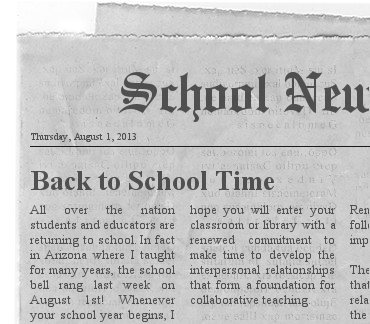
back_to_schoolAll over the nation students and educators are returning to school. In fact in Arizona where I taught for many years, the school bell rang last week on August 1st! Whenever your school year begins, I hope you will enter your classroom or library with a renewed commitment to make time to develop the interpersonal relationships that form a foundation for collaborative teaching.

When I taught fifth grade XX years ago, I made building a caring and collaborative culture in the classroom my top priority. As a new teacher at Harmony School, I did not understand the impact the entire school culture would make on the learning environment in Room #10. By the end of that first year, I surely did…

Since that time, I have spent the majority of my preK-12 teaching career in school libraries. From my very first library position at Elvira Elementary, I realized how the attitudes, values, and priorities of our principal, teaching colleagues, and staff affected teaching and learning in our school. And the parents who walked their children to school and hugged them so long at the gate and the bus drivers who gave bus riders their first school smiles of the day, all had a role in making our school a nurturing environment in which to learn and teach.

Here’s to an astounding year of discovery and in case you missed in last month, a little video to celebrate the caring community of school that is ready and waiting to welcome every learner: http://tinyurl.com/btrandw4u

Newspaper Clipping Image Created at Fodey.com

Leadership and Collaboration

1301014184_3786e4d2b8_mducks

As co-teachers and instructional partners, school librarians focus on collaborative opportunities with individual or teams of educators within a school community.  Many school districts have been providing professional development for educators by establishing Professional Learning Communities (PLC).   The PLC is a vehicle for collaborative planning and decision making that focuses on improving student learning.  To be successful participants, educators need training to understand the process for and commitment to collaboration that builds the collective capacity of a school system.  An effective PLC can change attitudes and transform teaching and learning in a powerful way.

School librarians are positioned to take leadership roles in PLCs, and should advocate for a place at the table.  Having honed a variety of collaboration skills of various levels, school librarians are familiar with setting goals, timelines, assessments, formulating projects, and are adept at analyzing data.  There are many configurations for PLC teams, and the school librarian should have a pivotal role in content areas.  Unfortunately, in many districts, the PLC teams may not integrate the school librarian into content or grade level groups.  Many times the PLCs are set to meet during the scheduled time for a class visit to the library/media center when the librarian is expected to supervise the class.  That prevents meaningful participation, and limits the expertise and knowledge that the librarian can share with the group.

Stepping into a leadership role means that the school librarian needs to be proactive and stay ahead of the curve.  Find out what is happening in your district or school.  What are the initiatives?  What are the goals for educators and student learning?  What curriculum changes are proposed?  Be ready to explain to administrators, teachers, parents, community members, and students how the school library program and resources will benefit the transformation of learning.  You are the expert, the information specialist, and can facilitate learning for all stakeholders.

If you want to realize your own capacity as an educational leader, I recommend two readings that have influenced my thinking recently.  One was an article in May/June 2013 issue of Knowledge Quest, “The Make-Good Mission.”  Michael Edson, the Smithsonian’s director of web and new media strategy, talks about the possibilities for the school library as a place for meeting the challenges of “scope, scale, and speed” presented by information in present day.  We simply can’t continue to do things the way we have done them in the past.  Organizations have to change from within, not top down.  We all have the capacity to contribute, not just receive information.

Change from within is one of the messages also in Leaders of Learning: How District, School, and Classroom Leaders Improve Student Achievement (DuFour and Marzano, 2011).  Two leaders in organizational systems and education explore how change and transformation can come about using the collective expertise of all stakeholders.  DuFour shares how PLC teams that are created and supported by district administrators and principals, can bring about improvements in student learning.  The training and support is imperative to make a successful outcome for all.  Collaboration skills have to be learned and the authors offer a blueprint.  Marzano clarifies how to establish what is important for students to learn and how to assess their learning.

At the AASL Conference in November 2013,  there will be sessions that focus on leadership roles and require specific collaboration skills.  Come to conference and gather more ideas to add to your leadership/advocacy tool kit!

Resources:

DuFour, Richard and Robert Marzano. 2011. Leaders of learning: How district, school, and classroom leaders improve student achievement. Bloomington, IN: Solution Tree Press.

Edson, Michael.  2013. The Make-good mission: Evaluating and embracing new possibilities for discovery and innovation in school libraries.  Knowledge Quest 41 (5): 12-18.

Photo: Microsoft clipart


International Collaboration

This summer has been all about travel and collaboration for me. A few years ago I develop an interest in school librarianship on an international basis and began to question if there were similarities and differences in the experiences and practices of school librarians in different countries. These questions have evolved into a research stream that has taken me from Europe to South America and allowed me to develop new partnerships too.

In my observations in Germany I did find that school librarians there are struggling with many of the same issues as we are here in the U.S., including some related to collaboration. The absence of collaboration practices was noted and many of the school librarians interviewed spoke of struggles with convincing teachers to collaborate and the importance of principal support for collaboration. Additionally, many of the school librarians interviewed talked about trying to institute “media literacy programs to teach their students how to be safe online,” but a lack of time was a problem because teachers would not dedicate time for this. Many commented that teachers only see the library “as a book place” and not as a “teaching place.” Also several of the school librarians interviewed commented that most people who are school librarians in Germany think this same way and do not recognize their own teaching role as a school librarian (Johnston, 2013).

I spent last week in Florianópolis, SC Brazil, attending the Brazilian Congress of Biblioteconomia (which is like the Brazilian equivalent of our ALA Annual Conference) with Dr. Lucy Santos Green from Georgia Southern University. As I listened to various presentations, I again heard many of these similar struggles with collaboration. In the days following the conference Dr. Santos Green and I visited several local schools to observe and interview the school librarians and yet again we heard the same issues related to collaboration.

Collaboration was definitely a theme that ran throughout the conference beginning with IFLA President Ingrid Parent speaking in the opening keynote address. Several of her comments resonated with me as she emphasized that collaboration must be a focus of librarianship and that by “working together at the national and international level we can be smarter, stronger, and louder.” I strongly believe that as school librarians around the world struggle with similar challenges, it is important to examine the work of school librarians on an international level and collaborate as professionals to develop strategies and a course of action for addressing our common problems.

IMG_6757Me, Carol Becker – our new Brazilian collaborator and friend, and Dr. Santos Green

Johnston, M. P. (2013). Investigating an international exchange of best practices between German and American teacher librarians. School Libraries Worldwide, 19(1).

The Art of Working Within Constraints

step one

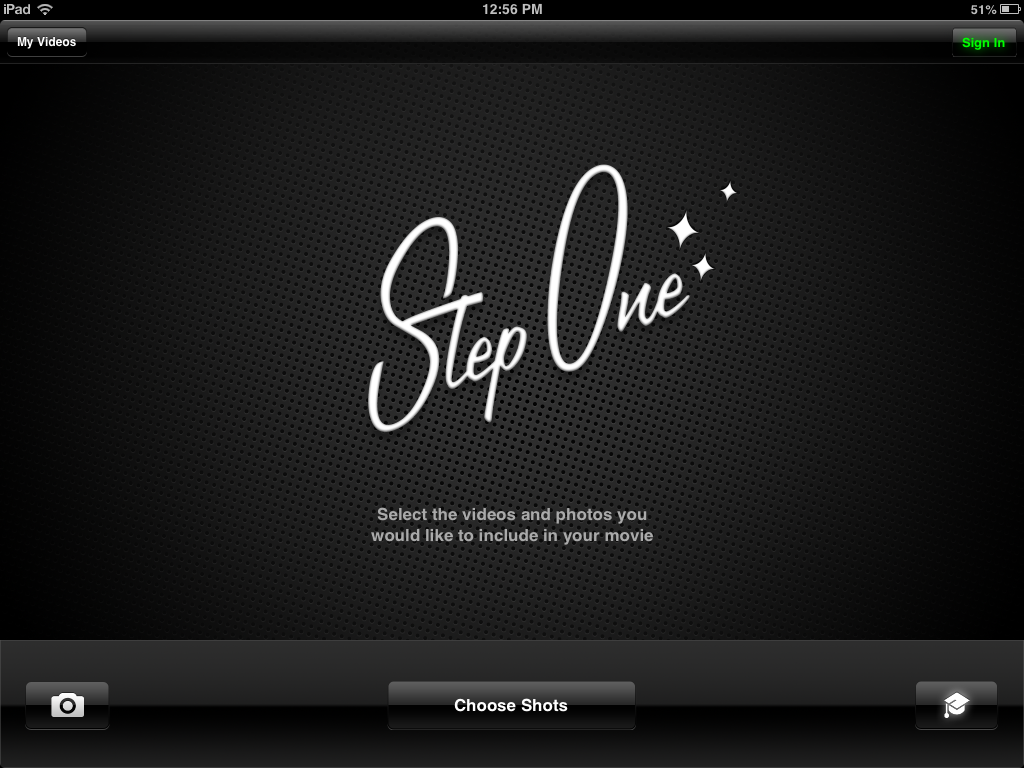
This summer students in two sections of our course Production of Instructional Materials, used a free IPad App, Videolicious to create quick video commercials on topics that ranged from how to use interlibrary loan to an introduction to the horror genre.  We were excited to see this app on the AASL Best Apps For Teaching and Learning list just released at ALA but we also knew first hand the limitations of the free app that we learned took lots of trial and error to realize a plan for combining video, still images, text, voice over and music.  Students collaborated ahead of time with a partner to create a storyboard for their video and then only had  a few hours on campus to pull it all together.  And wow! they did pull it together? Their videos were amazing and so much fun to view.  We talked about showing families how to use this free app on their devices or cell phones: think about the creative possibilities for students to share their learning!

The app clearly had its constraints and we had to remind students that this is a lot of what you deal with in the school library: learning to create something despite the constraints of time, money, and other resources.  This is what all artists have to work through: realizing an artistic vision despite the limitations of the materials or media chosen for the work.  As I think about this related to collaboration, I realize that we are also working with an idealistic vision of everyone working together to create learning opportunities for students.  We are also constrained by limited time and resources.  We have trouble finding enough time to plan together, or finding time in busy classroom schedules to provide adequate time for true student inquiry and creativity.  We find ourselves teaching students to use free apps on shared devices with filtered internet access.  And yet we believe in the vision and we persevere and some amazing things happen.

Finding a way to use the materials at hand to realize a vision doesn’t just apply to a two minute video assigned as coursework.  It’s a necessary frame of mind needed by those of us who hope to create a collaborative school culture.  The students who came to campus that afternoon with a plan knew where they wanted to go with their video.  They persisted through multiple trial and error attempts.  They worked together to find solutions that leveraged the materials they found around them. They learned from each other.  As school librarians, we hope they will have a vision, create plans in collaboration with others, persevere despite setbacks and limited resources, and continue to learn from their peers.

School librarians can create a culture of support, collaboration, and creativity with the teachers and students in their schools.  We are artists with access to a pretty cool palette of resources including those recently highlighted by the AASL Best Websites for Teaching and Learning 2013 and Best Apps for Teaching and Learning lists.  Give some of these resources a quick spin and be prepared to share them with your school communities.