A Village for Summer Reading

DSCN0324Dreaming of summer vacation?  We all do, but summer break for some students may mean they will come back in the fall at a disadvantage.  When the final bell signals the end of the school year, teachers, school and public librarians, parents, community members, and administrators should have a plan in place to support readers during the two month hiatus.  Remember the adage, “it takes a village…” Collaboration between all these groups should promote access to reading materials even while school is not is session, and research shows that children benefit from having books in the home.  Richard Allington, reading researcher and consultant, is the co-author of a new book, Summer Reading: Closing the Rich/Poor Achievement Reading Gap (Teachers College and International Reading Association, 2013).  In a recent SLJ blog, Curriculum Connections, (Eames, June 4, 2013) Allington answers questions and offers ideas for making a difference, and shows how all the stakeholders can collaborate for student success.  Be sure to put this book on your summer reading list!

In order to ensure that all children have opportunities to maintain literacy skills and fluency, we may need to change our school policies about materials that are usually locked away during the summer, and to find other creative ways to make sure books get into the hands of those kids who need them most, even if we risk losing some resources.

This is a topic of conversation that surfaces in school library circles in late spring-early summer.  Here are some ideas that have appeared recently within a variety listservs, blogs, and twitter.

  • Students are allowed to check out a certain number of books for the summer, returning them in the fall.
  • Genres of books are loaned to the public library for summer circulation.
  • Promotion of public library spaces, programs, and collections. Students get public library cards before they leave for the summer.  Some classes visit local public library, are introduced to librarians and programs for youth.
  • Some school libraries are open to students, parents, teachers for self selection and self checkout when the building is open, even if the teacher librarian is not there.
  • Summer reading blogs/social media sites for students offer a virtual space for sharing ideas and thoughts about books and other materials.
  • Newsletters and suggested reading lists (print and electronic) inform students, teachers, parents, administrators, and community members about summer reading.
  • Joint programs between school and public librarians are funded by grants.
  • Joint programs with local social support networks for children, such as Boys’ and Girls’ Clubs, YM/YWCAs, etc.
  • Little Free Libraries in neighborhoods, grocery stores, malls, etc.

And just for fun, here a couple of examples of what’s happening here in Vermont:

Beth Redford, school librarian at the Richmond (VT) Elementary School has a book bag program for all her students, K-4.  They are allowed to select ten books to take home for the summer.  Kids are really excited to participate.

Steve Madden, school librarian at the Camel’s Hump Middle School in Richmond, VT, has collaborated with the Vermont Department of Libraries and the Children’s Literacy Foundation, to write grants to construct and supply book collections for the Bolton Little Free Libraries.  Based on the Little Free Libraries in Wisconsin and elsewhere, book collections are set up in small enclosed bookcases in areas of Bolton, a town with no public library. Steve continues to refresh the collections that operate on the trust system.  His bike is set up for summer deliveries, too.  Little Free Libraries have sprouted up in lots of places in Vermont.  Is there one in your neighborhood? Would you like to start one?

What’s on your summer reading list?           

References:

Allington, R. and McGill-Franzen, A. (2013) Summer reading: Closing the rich/poor achievement gap. New York: Teachers College Press.

CLiF stocks little free libraries in Bolton, VT. (2012, July 3). Inspire kids! Children’s Literacy Foundation blog.  (Blog). Retrieved from  http://clifonline.wordpress.com/2012/07/03/clif-stocks-little-free-libraries-in-bolton-vt/

Eames, A. (2013, June 4)  Summer reading: closing the rich/poor achievement gap/ An educator responds to questions. Curriculum Connections  SLJ blog.  (Blog). Retrieved from http://www.slj.com/2013/06/curriculum-connections/summer-reading-and-the-richpoor-achievement-gap-an-educator-responds-to-questions/

Kelley, Kevin. (2013, June 12). At Vermont’s little free libraries, books aren’t going away. Seven Days online. (Blog).  Retrieved from http://www.7dvt.com/2013vermonts-little-free-libraries-books-arent-going-away

Little Free Library website. (2013, June 24)  Retrieved from http://www.littlefreelibrary.org/

Redford, Beth. (2013, June 10) RES newsletter.  (Blog)  Retrieved from: http://reslibrarynews.blogspot.com/2013/06/summer-library-books-resvt-cesuvt-vted.html?spref=tw


Best of KQ: Instructional Partnerships

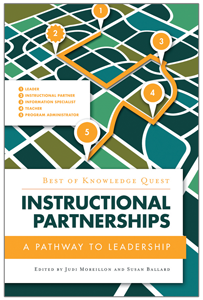
Best_of_KQ_IPsAlong with AASL President Susan Ballard, I co-edited the just-released Best of KQ: Instructional Partnerships: A Pathway to Leadership. Susan and I had the opportunity to select outstanding articles written by scholars, researchers, and practitioners in the field. Gleaned from more than a decade of issues of Knowledge Quest, the journal of the American Association of School Librarians (AASL), this book attests to the fact that the call to serve in the instructional partner role is not new AND it is timely!

Check out the press release on the ALA Web site.

In the changing landscape of 21st-century education, this role may be more imperative than ever. Whether your school is in the process of “reforming” or “transforming” the academic program (see Judy Kaplan’s May 28th post), it is essential that school librarians are fully engaged and yes, lead, in these efforts. The Best of KQ: Instructional Partnerships is organized in three categories: instructional partnerships in the broad context, research related to instructional partnerships, and classroom-library instructional partnership in action. The authors of the articles in the book provide a framework, research evidence, and examples from their own practice to help school library colleagues take the lead. Kudos to all of you!

Implementing instructional partnerships is not easy. It requires many of the “habits of mind” (Costa and Kallick) expected of 21st-century learners including flexibility, persistence, practicing critical thinking, reflection, and metacognition, and above all, continuous learning. If educators expect P-12 students to achieve these dispositions and practice these behaviors, then it behooves us to model these for them. Creating, developing, and sustaining instructional partnerships with colleagues is one way to do just that.

AASL has made the “Coteaching” Webinar that Susan and I hosted in March 2012 freely available on the Web for thirty days. Several authors from the KQ 40.4 “Coteaching” issue shared their experiences during the Webinar; some of their articles were reproduced in this Best of KQ: Instructional Partnerships monograph.

Works Cited

Costa, Arthur L. and Kallick, Bena. (Eds). Learning and Leading with Habits of Mind: 16 Essential Characteristics for Success. Alexandria, VA: Association for Supervision and Curriculum Development, 2008. Print.

Moreillon, Judi, and Susan Ballard. (Eds.) The Best of KQ: Instructional Partnerships: A Pathway to Leadership. Chicago: American Association of School Librarians, 2013. Print.

Transformation vs. Reform

For the past two decades, there has been a movement across the nation to “reform” education. The drumbeat of standards and accountability has dominated discussions about improving educational experiences for all children.  The term reform itself has a value laden connotation.  Think “reform” school…  Reform from the top down-identify the problem and fix it.  Instead, think about the term “transformation.”  It has a more positive connotation-a movement from one status to another through innovation.  Transformation comes from the inside out, in response to situations and experiences.

 

Meanwhile, as a culture, we are in the midst of a paradigm shift from an industrial to a technological age, and the transformation continues to redefine everything we have known. New norms are evolving in the business, political, cultural, and educational worlds.  We are a work in progress, as usual-exciting times!


What does this have to do with collaboration?


Collaboration skills are the key for transformation to an educational system for personalized learning, not only for students, but for educators, administrators, and other community stakeholders.  How do we learn and use those skills, and how do we teach our students to value and incorporate the contributions of all? How do we create environments and spaces that encourage creativity and collaboration for all learners? How does technology enhance the learning experience?


These big ideas were explored by the keynote speakers at the Dynamic Landscapes Conference at Champlain College in Burlington, Vermont on May 16-17, 2013.  Jointly sponsored by Vita-Learn and the Vermont School Library Association, the annual conference showcases exemplary practices of statewide educators and invites national experts to address contemporary issues in education.   Last week Ira David Socol, Pam Moran, and Steve Hargadorn spent several days visiting Vermont and sharing their expertise with attendees at the conference.  Ira, an educational consultant and historian is currently working in the Albemarle County School District in Virginia where Pam is the superintendent.  They are leading transformation through a collaborative model with educators in the local schools, and they shared their ideas and progress in encouraging innovation that focuses on personalized learning.  Digital technology tools are integrated across the curriculum to enhance deep learning, collaboration, and engagement.  Take a look at the videos for the Iridescent Classroom on Ira’s web site to get a glimpse of their work together. He also has a terrific overview of the history of education that contextualizes where we are today.  Lots of resources there to explore, so take a look!

Steve Hargadorn, of Classroom 2.0, and Library 2.0, presented an overview of the process of how technology is changing our culture, and how that change will impact education in the future.  Real educational transformation will come about with the evolution of the culture, so stay tuned.    He shared many examples of how the cultural shift is happening due to the impact of social media and technology applications. Here is a link to his slides DynamicLandscapes2013Hargadon that demonstrate the shifting sands of the 21st Century. As I said before-exciting times ahead…

Once again, I was struck by aha moments, as I listened and learned.  As educational leaders in our schools, teacher librarians are pivotal in the transformation process embedded in collaboration.  As Steve Hargadorn said, “Be ready to unleash energy and potential through participation, creation, sharing, and engagement.”

Are you ready?

References:

Dynamic Landscapes Conference 2013. Web site.  Retrieved from  https://sites.google.com/a/vita-learn.org/dynamiclandscapes2013/home/th-keynote

Classroom 2.0. (2013). Web site. Retrieved from http://www.classroom20.com/

Hargadon, Steve. (2013).  Education,Technology, Social Media, and You.  Web log. Retrieved from http://www.stevehargadon.com/

Hargadon, Steve. (2013). Educational Network is the Learning Revolution: Future of Education. Dynamic Landscapes Keynote address, May 17, 2013. (PDF).

Library 2.0 (2013). Website. Retrieved from http://www.library20.com/

Moran, Pam. (2013). Superintendent’s Blog: Albemarle County Schools. Web log. Retrieved from http://superintendent.k12albemarle.org/

Socal, Ira David. (2013). Challenging the Systems. Web site. Retrieved from https://sites.google.com/site/iradavidsocol/

Microsoft Clipart: Crystal ball.


Global Collaboration: CiSSL International Research Symposium

globe

A few weeks ago I attended the Third International Research Symposium at Center for International Scholarship in School Libraries (CiSSL) in New Brunswick, NJ . The theme this year was Digital Youth, Inquiry, and the Future of the School Library … Research to Practice.

The focus question was: How can schools prepare to deliver a 21st century education for digital youth?

I always like to sit at a table with people I don’t know when I go to these types of conferences or workshops so that I meet new and exciting school librarians. I have met some of my now dearest friends and favorite co-collaborators that way. And the same was true for this event! I sat at a table with some wonderful school librarians and school library coordinators from Maryland, Virginia, and Washington. I experienced two full days of engaging and energized learning with this group. We brainstormed as a group on what we think schools should be doing to address the needs of today’s learners. Then we listened to a variety of speakers that included international guests, practitioners, and academics speak on their views, experiences, and research in this area.

Another focus of the conference was also to celebrate 10 years of CiSSL and 30 years of Dr. Carol Collier Kuhlthau’s research centering on the Information Search Process and Guided Inquiry.  Guided Inquiry serves as a framework that can give learners a foundation for developing deep knowledge and understanding. It was inspiring to hear Dr. Kuhlthau speak on how she developed the Information Search Process from observing real world students and their information needs and seeking processes. Also her daughter Leslie, who is also her co-author, spoke about bringing in the teacher’s point of view to this process and how they developed the Guided Inquiry Design book. Practitioners from across the globe including England, Sweden, and Australia shared how they were using the guided inquiry framework and new technologies to address the information needs of digital learners and learning in a variety of environments.

It was great to see the element of collaboration in each of these presentations – how school librarians and teachers were working together to create deeper learning experiences for kids. It was refreshing to see and hear about these experiences and to experience some good professional collaboration myself. I often find that I learn just as much from my colleagues through informal chatting as I do the formal presenters. It was a treat to get to talk with and share ideas with school librarians from across the globe. As we enter the summer, be sure to think about yourself and your own professional growth – what do you have planned to expand your thinking and grow your network?

Cultivating A Garden of Collaboration

We’ve had a cold spring, but finally the ground is warming up.  As the sun set last night, my husband and I put in a small garden: tomatoes, squash, okra, eggplant, and melon plants and some bean seeds.  Overnight we had some welcome rain and the corn in the farmer’s field behind our house appears to have grown a foot.  Another farmer nearby has planted a field of potatoes, and my husband chuckles when he remembers the first time I dug up potatoes.  I thought I had found buried treasure as right below the ordinary surface of the garden, I uncovered these rounded jewels.  A garden provides these small surprises almost daily.  I will eagerly watch that row of bean seeds for the delight of those first, green leaves.  I believe we put in a garden as much for these small daily gifts as for the vegetables we hope to harvest.

Where I’ve been fortunate to be a part of a “culture of collaboration,” I have found the same sort of delight in planning with other professionals.  There’s the same sense of putting your hands in the dirt and coming up with nuggets of great ideas that will nourish the learning of our students.  Or, planting seeds of lesson ideas and walking into a classroom several days later to discover they have sprouted into student projects on walls and desks.  Or, receiving an unexpected rain of support from an administrator, who recognizes the importance of collaboration and allows it to grow in unexpected ways.

Often, I believe it’s the small gifts that cultivate and sustain a collaborative culture.  When we meet face-to-face, there is the chocolate on the table, the family photographs someone shares from their phone, or the humorous classroom anecdote shared by a teacher. It’s quite simply the laughter, the raised eyebrows, and the sharing of a time and a space.

Many of my collaborations today take place online.  It’s exciting to meet with colleagues around the country or in Australia.  We share documents in GoogleDocs or Dropbox.  But I often find myself wondering online, “where’s the chocolate?” or “what small gifts might I offer to sustain this relationship?”  Because ultimately, while the collaboration is task-oriented, it’s the relationships that provide the rich soil, sunlight, and rain needed to nourish and grow that work. Relationships provide the medium for collaboration.  They are the heart and the chocolate, and we need to find the small ways to nourish those relationships whether it’s face-to-face or online.

custom image


Cross Pollination of Ideas and Understandings

Spring is finally emerging here in the North Country, and the bees are buzzing, birds are singing. Melissa’s post last week about encouraging partnerships with public and other libraries had me thinking about collaboration as a cross pollination of ideas and understandings. When school librarians have a chance to meet and work with others in the field whose overall mission is the same, but different according to parameters of their workplaces, the benefits move both ways.

Earlier in the year, I was invited to present at the New England Association of Independent School Librarians at their annual meeting on April 12, 2013. While I was excited to take on the task, I realized that I really had limited first-hand knowledge of independent schools, and I was eager to learn more. My background includes many years in the public school system and in a public university, so I did a bit of digging to understand my audience. What I found is that there is a range of independent schools for students of all ages, from those that are focused on college prep, to those that provide a niche environment for learning depending on the interests and abilities of the student. While independent schools are governed by a board of trustees, some are combinations of private/public schools, some are based on religious or organizational affiliation, and many are funded exclusively by tuition, donors, and endowments. They include day schools and boarding schools and are not for profit, and are not encumbered or constrained by public school regulations.

Libraries are an important part of the school experience in independent schools, and are often extolled as indicators of the quality of the school. The National Association of Independent Schools has established Guidelines of Professional Practice for Librarians, and there are many regional independent school library organizations.  There is a separate section within the American Association for School Librarians (AASL) for Independent Schools (ISS), and therefore, independent school librarians have access to professional networks that meet their particular concerns, which are not so different than those of public school librarians.

The April NEAISL meeting was held at Burr and Burton Academy in Manchester, Vermont, and attendees came from across New England and upper New York State, in spite of the snow, sleet and freezing rain that is typical of early spring in Vermont.  Susan Ballard, AASL President, was the keynote speaker who suggested ways to advocate for school libraries through marketing or branding, a topic that resonates with all school librarians.  Throughout the day, in formal sessions and informal discussion, I listened for the common themes that connected independent school librarians. Enthusiastic about their work and their schools, they voiced familiar concerns about:

  • Effective technology integration
  • Engaging digital native students in learning
  • Advocacy
  • Changing space needs for libraries-learning commons
  • Diversity or lack of diversity in student populations
  • Collaboration with other faculty
  • Students with special needs or ELL
  • AP courses-yes or no
  • College research ready

While I did not hear very much about Common Core Standards, I must admit, it was a relief not to have that on the table.  As I listened and learned from independent school librarians, I realized more than ever, that dedication to library service for students and staff is the common denominator for all of us in the profession.  No matter where we work,   in urban or rural areas, in large or small public or independent schools, we are all committed to our mission, and we have a lot to share. I want to thank Merlyn Miller, Library Director at Burr and Burton for the opportunity to share, listen, and learn with such a diverse group of professional school librarians.

In order to take advantage of cross pollination of understandings, I urge you to seek out your fellow school librarians to compare notes and ideas. If you are in a public school, plan to visit a local independent school.  If you are in an independent school, locate a nearby public school.  There is a lot to learn from different perspectives, and enjoy your visit!

References:

American Association of School Librarians Independent Schools Section. Online. http://www.ala.org/aasl/aboutaasl/aaslcommunity/aaslsections/iss/iss .

Conference program for New England Association of Independent School Librarians. Online. https://sites.google.com/a/burrburton.org/new-england-association-of-independent-school-librarians-conference-2013/conference-program.

Guidelines of professional practice for school librarians. National Association of Independent Schools. Online. http://www.nais.org/Series/Pages/NAIS-Guidelines-of-Professional-Practice-for-Librarians.aspx. .

Hand, D. Independent school libraries: Perspectives on excellence. (2010). Santa Barbara, CA: Libraries Unlimited.

National Association of Independent Schools. Online. http://www.nais.org/Articles/Pages/About-NAIS.aspx?src=utility.

Cross Pollination of Ideas and Understandings

Spring is finally emerging here in the North Country, and the bees are buzzing, birds are singing. Melissa’s post last week about encouraging partnerships with public and other libraries had me thinking about collaboration as a cross pollination of ideas and understandings. When school librarians have a chance to meet and work with others in the field whose overall mission is the same, but different according to parameters of their workplaces, the benefits move both ways.

Earlier in the year, I was invited to present at the New England Association of Independent School Librarians at their annual meeting on April 12, 2013. While I was excited to take on the task, I realized that I really had limited first-hand knowledge of independent schools, and I was eager to learn more. My background includes many years in the public school system and in a public university, so I did a bit of digging to understand my audience. What I found is that there is a range of independent schools for students of all ages, from those that are focused on college prep, to those that provide a niche environment for learning depending on the interests and abilities of the student. While independent schools are governed by a board of trustees, some are combinations of private/public schools, some are based on religious or organizational affiliation, and many are funded exclusively by tuition, donors, and endowments. They include day schools and boarding schools and are not for profit, and are not encumbered or constrained by public school regulations.

Libraries are an important part of the school experience in independent schools, and are often extolled as indicators of the quality of the school. The National Association of Independent Schools has established Guidelines of Professional Practice for Librarians, and there are many regional independent school library organizations.  There is a separate section within the American Association for School Librarians (AASL) for Independent Schools (ISS), and therefore, independent school librarians have access to professional networks that meet their particular concerns, which are not so different than those of public school librarians.

The April NEAISL meeting was held at Burr and Burton Academy in Manchester, Vermont, and attendees came from across New England and upper New York State, in spite of the snow, sleet and freezing rain that is typical of early spring in Vermont.  Susan Ballard, AASL President, was the keynote speaker who suggested ways to advocate for school libraries through marketing or branding, a topic that resonates with all school librarians.  Throughout the day, in formal sessions and informal discussion, I listened for the common themes that connected independent school librarians. Enthusiastic about their work and their schools, they voiced familiar concerns about:

  • Effective technology integration
  • Engaging digital native students in learning
  • Advocacy
  • Changing space needs for libraries-learning commons
  • Diversity or lack of diversity in student populations
  • Collaboration with other faculty
  • Students with special needs or ELL
  • AP courses-yes or no
  • College research ready

While I did not hear very much about Common Core Standards, I must admit, it was a relief not to have that on the table.  As I listened and learned from independent school librarians, I realized more than ever, that dedication to library service for students and staff is the common denominator for all of us in the profession.  No matter where we work,   in urban or rural areas, in large or small public or independent schools, we are all committed to our mission, and we have a lot to share. I want to thank Merlyn Miller, Library Director at Burr and Burton for the opportunity to share, listen, and learn with such a diverse group of professional school librarians.

In order to take advantage of cross pollination of understandings, I urge you to seek out your fellow school librarians to compare notes and ideas. If you are in a public school, plan to visit a local independent school.  If you are in an independent school, locate a nearby public school.  There is a lot to learn from different perspectives, and enjoy your visit!

References:

American Association of School Librarians Independent Schools Section. Online. http://www.ala.org/aasl/aboutaasl/aaslcommunity/aaslsections/iss/iss .

Conference program for New England Association of Independent School Librarians. Online. https://sites.google.com/a/burrburton.org/new-england-association-of-independent-school-librarians-conference-2013/conference-program.

Guidelines of professional practice for school librarians. National Association of Independent Schools. Online. http://www.nais.org/Series/Pages/NAIS-Guidelines-of-Professional-Practice-for-Librarians.aspx. .

Hand, D. Independent school libraries: Perspectives on excellence. (2010). Santa Barbara, CA: Libraries Unlimited.

National Association of Independent Schools. Online. http://www.nais.org/Articles/Pages/About-NAIS.aspx?src=utility.

School Library and Public Library Collaboration

As we were gathering articles for the 2013 March/April issue of Knowledge Quest one of the areas Ann Martin and I chose that we would like to highlight was the partnership between school and public libraries. And while I am sure there are great examples out there, I was amazed that this still seems to be an area where we as school librarians can grow.

In looking back through School Library Research there is really only one piece of research dealing with this partnership. In 2000 Fitzgibbons explored successful cooperative partnerships between school and public libraries, what these partnerships looked like and what factors have to be considered in forming these successful relationships.

This also came to mind as I reflected on the semester as it comes to a close. This semester in both of my courses, that are focused on school library topics, I had students who are not on the school library certification track enroll in each of these courses. I went from wondering why they were taking those courses to enjoying the different views and perspectives they brought to our class discussions. They in return expressed that they had learned more about what school librarians actually do and of course most of them were surprised at the many roles of the school librarian.

This experience made me wonder if we are perhaps not doing all that we could in preparing school librarians to encourage this partnership, and if maybe we are even hindering it’s development. I say this because all too often school librarians have take different classes from other MLIS students that are more specialized and needed for certification and even when they are in general MLIS classes you will often see groups for group work created by type of library focus. After this semester and seeing the great projects and ideas that came from the school library students working with the public and academic library students I will be encouraging these in the future. I think this type of learning experience can go further in promoting these relationships than hearing me say over and over again “you really should be partnering with your local public librarian.”

Fitzgibbons, S. A. (2000). School and public library relationships: Essential ingredients in implementing educational reforms and improving student learning. School Library Media Research, 3. Retrieved from http://www.ala.org/aasl/aaslpubsandjournals/slmrb/slmrcontents/volume32000/relationships

Image: http://www.publicdomainpictures.net/view-image.php?image=19960&picture=hands-holding-jigsaw”>Hands Holding Jigsaw</a> by Petr Kratochvil

Doorway Musings

 “What are we doing today?” Jerome asks as his class walks into the library. Their teacher, Mrs. Jones has just left them at the door. “I’m going to tell you, just wait,” I respond having designed a research project (in conversation with some of the grade level teachers) to prepare fifth graders for an upcoming overnight and out of state field trip. “Oh, Mrs. Jones just said you could read a story to us, she didn’t care.” Jerome’s remark hit me in the gut. It didn’t matter how hard I had worked at this school to reach out to teachers in order to plan meaningful library lessons that were integrated with their curriculum. For some teachers, the only value they saw in the school library was a place to drop their students for forty-five minutes. Other teachers would tell me as they left their students at the door, “Oh, by the way they need to check out a biography today,” and I would be faced with the choice of  whether to teach the lesson I had prepared or to drop that plan and teach about biographies, or to do both in a rushed and incomplete way. The library had a revolving door with classes lining up to leave as other classes were lined up outside the door to come in. I was busy; I worked hard and felt good about reaching every child every week. But my doorway told this story: classroom teachers stopped here to leave and pick up. They didn’t really know what happened on the other side of the door, some didn’t really care, and the culture of this school  (and its scheduling of the library) allowed this to happen.

This is one of the more painful and revealing memories I have of my first professional school library position in an elementary school with a fixed schedule. Judi’s post about creating a school culture that supports collaboration brought this flooding back to me.  Implicit and important to the shared practices that express a culture’s values are the ways of understanding and using time.   Time is one of the most important resources we have in a school and we should use it in service of student learning not the other way around. In 1994 the National Commission on Time and Learning prepared a report about American schools entitledPrisoners of Time” criticizing schools’ promotion of schedules and grade level expectations as being more about time and time served than about student learning.  How can we continue to afford this?

Years ago, Donham Van Deusen and Tallman’s research demonstrated that schools with a flexible schedule included more collaboration between teachers and the school librarian (1994).  We recognize collaboration as a best practice and this blog celebrates and promotes librarians and teachers planning together.  Yet we cannot remain silent about the continuing practice in elementary schools of fixed schedules that thwart our efforts at collaboration and undermine our ability to infuse the school curriculum with twenty-first century skills, resources, and tools.  Judi’s research that pre-service teachers eager to collaborate with school librarians encountered numerous barriers including the library schedule and the school librarian should be a wake-up call to us all (Moreillon, 2008).  Our doorways should tell the stories of eager learners and instructional partnerships not rigid schedules and rigid mindsets.

References

Donham van Deusen, J. and J. Tallman. 1994. The impact of scheduling on curriculum consultation and information skills instruction: Part one, The 1993–94 AASL/Highsmith Research Award Study. School Library Media Quarterly 23(1): 17-25.

Moreillon, J. (2008). “Two Heads Are Better than One: Influencing Preservice Classroom Teachers’ Understanding and Practice of Classroom–Library Collaboration”, School Library Media Research.  Chicago: American Library Association, September 24, 2008. http://www.ala.org/aasl/aaslpubsandjournals/slmrb/slmrcontents/volume11/moreillon

National Commission on Time and Learning (1994).  Prisoners of Time.  Washington, D.C.  Accessed online:  http://www2.ed.gov/pubs/PrisonersOfTime/index.html


Collaboration and Mentoring-Take 2

Be the change you wish to see in the world…

Mohandas Gandhi

Barbara Stripling, President Elect of ALA, was the keynote speaker at a recent Massachusetts School Library Association Conference (March 2- 4, 2013). As a mentor, she encouraged those attending to “be the change,”  to make a difference by changing  one life at a time, and helping students raise their own dreams, skills, and dispositions of inquiry. Weaving the themes of collaborative relationships, decision making, and problem solving, she shared a vision of a vibrant model for student centered learning in 21st Century schools.  Her passion and commitment to the field of librarianship and education is both inspirational and challenging. How can we live up to this ideal?  I guess we just have to work harder at what we do best, so that we can be the change, too.

Two colleagues and I traveled from Vermont to Sturbridge, Massachusetts to participate in a three day event that allowed us to rub shoulders with Barbara Stripling, Richard Byrne, Pam Berger, and a host of authors, including Jack Gantos.  We were excited to meet and talk to our compatriots from another New England state to compare notes about school library issues.  We were also meeting some of our Twitter friends for the first time face to face.  Sitting in a large conference room, it was amusing to overhear people saying, “So there you are!  It’s so wonderful to meet you in person after getting to know you through your blog or Twitter.”  Having a chance to sit down and chat with the presenters between sessions, or during lunch and dinner provided a personal experience that you don’t have every day.

As in other sections of the country, in New England and the Northeast, there are opportunities within reasonable driving distances for collaboration and mentoring at regional/state school library conferences and meetings.  Many teacher librarians can’t afford to go to national conferences very often, or at all.  Some have no financial support from their districts for professional development other that what is provided at the local level.  State professional organizations play an important role in bringing national speakers and showcasing best practices within the field to a gathering of folks who come to share ideas, connections, and to make or renew friendships.   PLNs now put practitioners in touch with others throughout the nation, and also provide connections within a geographical area, too.  Social media and Twitter feeds allow everyone to communicate and collaborate across time and space.  There are so many different ways to mentor and be mentored, in our fast paced world, but face to face collaboration is still a very powerful way to connect the dots.

Having returned from the conference with many new ideas and new relationships, I am already putting plans into action that will affect my teaching and learning.  Coincidentally, once again, the current issue of Knowledge Quest : Mentoring Through Partnerships continues to look at collaboration, and the role of professional organizations is seen as a venue for mentoring.   Melissa Johnston shares her conclusions from some research about technology leadership in Knowledge Quest  (2013, 38), “Not only do professional organizations provide support for school librarians through relationships with other school librarians, but this research finds that professional growth opportunities from  professional organization activities such as conferences and publications serve as enablers as well.”  From my own experience, I can’t agree more!  And as a final note, when I was doing a school visit last week, I went into the school library, and there  inscribed on the wall was a familiar message: Be the change you wish to see in the world.  I felt as if I had come full circle.


Barbara Stripling elected ALA president (2011). School Library Journal (May 4, 2012) http://www.schoollibraryjournal.com/slj/home/894466-312/barbara_stripling_elected_ala_president.html.csp

Johnston, M.P. (2013). The importance of professional organizations and mentoring for leadership. Knowledge Quest 41(4). http://www.ala.org/aasl/knowledgequest

Massachusetts School Library Association Conference: Lead & Learn (2013).  http://maschoolibraries.org/content/view/1046/704/