Principal All-Stars

Soccer Player Going for the Goal


When administrators appreciate the value of a school library program, led by dynamic and knowledgeable teacher librarians, they understand that collaboration is the root of successful teaching and learning for the school community.   They also understand the return on investment in the multiple roles of the school librarian-in literacy, professional development, technology integration, and instruction.  Usually that one person collaborates on many levels with everyone, students and educators, at one time or another. Teacher librarians are masters at the spinning plates act-and are passionate about their work.

Other administrators are not always sure what teacher librarians do, so how can we begin to shift that paradigm?

Joyce Valenza, in a recent post on her Neverending Search Blog (April 5, 2014) featured a film titled “Principals Know: School Librarians are the Heart of the School.”  Dr. Judi Moreillon and Dr. Teresa Starrett at Texas Women’s University collaborated to create this powerful message.  The film and Joyce’s interview with Judi provide a scenario for reaching administrators in pre-service programs.  Testimonials by principals across the country reflect the ongoing day to day contributions of teacher librarians in the field, not just theoretical research.  (There is plenty of that elsewhere, too!)

Support for ongoing school library programs requires conversations about the benefits of a school library program, among all stakeholders.  Principals, superintendents, curriculum directors, and other school district leaders who begin these conversations while they are in training, come to administrative positions better prepared to make educational decisions about school library programs.

Another potential value of this film is for advocating the value of school libraries with school boards, local district administrators, and other community members.    Be sure to bookmark the links from today’s post, so that you can have them at your fingertips for future advocacy.  Keep building that advocacy toolbox!

References:

Valenza, Joyce. (2014, April 5)  Principals know: school librarians are the heart of the school.  Neverending Search.  (weblog) http://blogs.slj.com/neverendingsearch/2014/04/05/principals-know-school-librarians-are-the-heart-of-the-school/

Image: Microsoft Clipart



Practicing What We Preach

Each semester I teach my students the importance of collaborating and co-teaching with teachers, but now as a school library educator I miss that daily collaboration and exhilaration of co-teaching I experienced as a school librarian. So that I got to have two valuable collaboration experiences this past month was very exciting!

First was a meeting with the other school library educators across the state of Alabama. As being one of the newest educators in the state, this was especially valuable for me! This meeting allowed time to get to talk about issues that we all face such as certifications and state standards, but also to exchange teaching ideas and share how we are designing our courses and internship experiences. In order to stay in touch and continue to share we now have a Google Group and space to share. I have shared this with some of my students and they have embraced this idea as one they could implement with various grade levels to foster that anytime anywhere collaboration that today’s technology makes possible.

Second was working with the amazing Buffy Hamilton to teach my class. We chatted about what I was currently teaching in my class and how she thought she could contribute to their learning. It was a new experience for me being more in the teacher role in this collaborative relationship. What a great learning opportunity this was for my students too! They were engaged and excited as they learned about things from a different perspective – just as classes are when the school librarian steps into that co-teacher role.

These two experiences and end of the year reflection have made me think about how I can work to incorporate more collaboration and co-teaching into my own practices. As the end of the school year draws closer it is that time for self-reflection and to look back on your practices this past year and ask yourself “How have I done this year?” – no matter what level you teach.

In A Relationship: It’s Complicated

What should learners hold us as school librarians accountable for? Clearly one area would be categorized as information literacy.  I’ve been pondering what this means and have begun to think of it as developing a relationship with information that includes understanding how to locate, evaluate, apply, create, and share information.  But beyond these skills and actions, our Standards for the 21st Century Learner also point toward important dispositions or habits of mind including recognizing a need for information, possessing the curiosity, persistence and judgment to seek out, evaluate, and select information, and the creativity and persistence (again) to apply information in new ways to new problems and new solutions.  We want learners who will not only consume, but produce new knowledge and information.  Learners need to reflect and assess their own products and process in order to continuously improve.  We want learners who will push their own boundaries and the boundaries of their communities.

Community adds another layer of complexity to our relationships with information and knowledge.  Because we believe that learning is social and information is a social good, we want learners to seek and draw on the expertise of others at every step in the information seeking and knowledge creation process.  How do we as school librarians promote this social aspect of information literacy when it comes to dispositions?  How do we teach students to seek and provide support for each other when it comes to persistence, curiosity, reflection, and self-assessment?  One way is to actively seek and provide feedback and evaluation to each other.  We can model support, encouragement, and sharing the work as collaborative partners.

But it also occurs to me that these social aspects of our relationship with information are not always easy.  Conflict and challenge may be necessary to push ourselves and our communities into new directions and toward new knowledge.   Students need honest critique and are likely to experience disagreement, friction, disappointments and failure.  Our relationship with information is complicated and not always gentle, particularly as we seek to become producers not just consumers.  We can help our students as well as ourselves and the professionals we work with to learn to let go and push through a sense of loss toward new learning and knowledge.  It’s complicated but it’s a living and growing endeavor.

Swiss Army Knives: Teacher Librarians

12065701021002992326klsgfx_Swiss_Army_Knife.svg.med

Looking for some cool tools in your classroom?  Think about the utilitarian roles of the teacher librarian-think Swiss army knife.  That’s how one teacher describes the impact of the teacher librarian in schools.  In a recent blog post on Edutopia, Josh Work, a middle school teacher from Maryland, shares his take on collaboration that is at the heart of his daily practice in his school.  That collaboration in teaching and learning is with the teacher librarian. This blog is a must read for all of us who strive every day to become embedded in the educational fabric of schools as teacher librarians/media specialists.

From Josh’s experience, he sees the teacher librarian as a leader in the implementation of the Common Core State Standards and technology integration.

“I have found the most valuable school-based resource for brainstorming, discussing, planning and implementing anything to do with technology has been my school’s media specialist.”

“…Media specialists are an amazing building-level resource for anyone that takes the time to collaborate with them.”


As in many cases, the collaboration began in simple ways, with a quick face to face conversation that grew over time to brief meetings, and then later to include co-planning and co-teaching curriculum. He also goes on to give some advice to other teachers about enlisting help from the building media specialist/teacher librarian.

Whether or not the Swiss army knife is an image you have of yourself, it’s great to learn about successful collaborations with teachers from another perspective. In fact, the metaphor does represent the multiple facets of our morphing role, so let’s embrace it.

Hearing from colleagues such as Josh who understand and appreciate the expertise and knowledge that we provide, is refreshing, and affirms the work that we do. It also gives us incentive to try harder, even in the face of budget cuts and increasing demands on teachers’ time.  Together, we all can make the shift in instructional design and practice if we continue to embrace partnerships to meet the challenges of teaching and learning in today’s world.

Thank you, Josh, from the bottom of our hearts.  We think you are sharp, too!


References:

Work, Josh. (2014)  “The Shift: Media Specialists and the Common Core.” Edutopia  (weblog) March 18, 2014. http://www.edutopia.org/blog/media-specialists-and-common-core-josh-work

Image: Clkr.com: Swiss army knife


Forging Partnerships With Teen Tech Week

Last week I followed along on my own PLN with the great things that school librarians were doing for Teen Tech Week 2014. The theme of DIY @your library promoted the library as place to extend learning beyond the classroom for teens. It was great to see was how it facilitated differing partnerships between school librarians and teachers, students, parents, community, and the public library.

One example that really struck home with me was Norcross High School, where Buffy Hamilton and her colleagues provided a week of digital delights, both low and high tech, to engage many types of teens. You only have to watch a minute of the videos she posted to see students engaged in creative play to learn. They were there during their lunchtime to enjoy collaborative time with their peers, as well as learn along with their excellent school librarians.

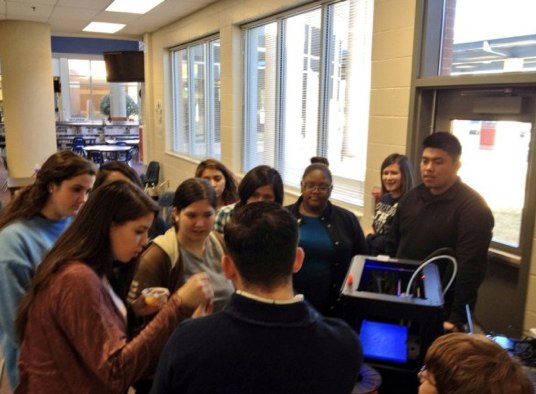
As a finale for Teen Tech Week and a kickoff for their partnership with Gwinnett Public Library, members of the public library team brought over a 3D printer to share with the students. It was amazing to see the excitement and awe on these students’ faces and the thoughtful reflections they shared. Not only did the group of students coming to the library for Teen Tech week activities increase throughout the week, but also I am guessing that the word is getting out about the cool things going on in the library. This is going to be a partnership to watch in the future for great things to come.

Often school librarians question how to enact the technology leadership role in practice – this is a great example!

Partnering for Possibilities_ NHS Media Center, Gwinnett County Public Library, 3D Printing, and More | The Unquiet Librarianhttp://theunquietlibrarian.wordpress.com/

We are Not Alone!


Eifel Tower


A recurring theme that we have explored in this blog has to do with establishing an environment for collaboration within a school community.  Who should be the leader?  What should it look like?  What is our role?  How do we define collaboration?  Who does it benefit?

We are not alone.  These are not questions that are unique to the teacher librarian perspective, but are being asked again and again by others who are trying to shift the paradigm in teaching and learning.   Moving from an isolated classroom to co-teaching in a variety of learning spaces requires rethinking possibilities for instruction.   Derek Hatch, a contributor to the Connected Principals Blog, posted on Feb. 7, 2014, “True collaboration is a very important skill and it is something that I believe we need to teach our students…both directly and by example.”  As an administrator, he lays out his vision of nine components present in true collaboration, and they all sound very familiar. Adults lead by modeling, shared vision, trust, time, flexibility, understanding roles, commitment, shared leadership, and risk taking. For teachers to teach students to collaborate, they need to talk the talk, and walk the walk.

One of the most important things that an administrator can do to improve collaborative practice within a school is to establish a shared vision, and secondly, to allow time and flexibility for all teachers, not just classroom teachers, to explore and refine ideas about collaboration. Without the time to really delve into collaborative teaching, and the flexibility in schedules and expectations, teachers will find it hard to move forward on the other components that Hatch lists. That is a real challenge, and the commitment needs to be there to build and continue collaborative relationships over time, not just one year.

As Melissa suggested last week, the 7 Spaces for Learning should also be part of that vision. Let’s get out of the classroom and into the world, physically and virtually.  In this day and age, we are not confined by four walls, learning happens in multiple places and dimensions.  There are many exemplars to guide the way.  Just look for successful collaborative teaching projects that are shared through school websites, Youtube videos, Twitter and other social media.

Here’s an example of a school where collaboration is valued and celebrated.  Find out how a whole school in rural Vermont took a trip to Paris, France.  Enjoy the tour!


References:

Hatch, Derek. (2014). “More on Collaboration: Essential Ingredients.”  Connected Principals (weblog) Feb 7, 2014.  http://connectedprincipals.com/archives/10189  

Kelly, Julie. “Welcome to Paris.” (2014).  WCAX News. Feb 20, 2014 http://www.wcax.com/story/24778900/welcome-to-paris 

Image: Classroom Clipart c.2011


Collaborative Spaces

This past weekend as I was preparing to teach my students about facilities and designing a school library learning environment I revisited the 7 Spaces of Learning and how these apply to the school library. These include: Secret Spaces, Group Spaces, Watching Spaces, Performing Spaces, Participation Spaces, Publishing Spaces, and Data Spaces.

Matt Locke first came up with the concept of the Six Spaces of Social Media and then Ewan McIntosh, a European expert in digital media for public services, and his team team added a seventh, Data Spaces. They have taken this idea of digital spaces -where we interact and with whom we interact with in each space and have defined what that would look like in a physical environment. Here is a 15 minute video explaining these thoughts:

The Seven Spaces of Technology in School Environments from NoTosh on Vimeo.

They have explored how education can harness these spaces to not only meet the needs if their current students and existing practices but as “influencers of future practice” by providing spaces for projects and learning in the future.

In class this week as we discussed meeting the needs of our learners it was interesting to see how the various modalities of learning including, independent study, peer tutoring, team collaborative work, one on one learning, lecture format/teacher centered, hands on project based learning, technology based learning, distance learning, research, presentation, performance, social, and emotional, seem to align with the 7 Spaces of Learning.

Collaborative and social learning are important aspects of 21st education and are prominent in the AASL Standards for the 21st Century Learner as well.  School libraries are becoming more and more places for teams to work together formally and informally, but the question  arises – are we providing students with the right environment where they can work and learn collaboratively?

And are we asking students for their input? See what happens when a third grade teachers asks her students to design their Secret Space.

Before We Throw Out the Bathwater

rubber duckJudi’s questions about linking individual teacher evaluation to individual student achievement highlights a real conundrum in educational research and best practices. I almost have the sense that we are holding onto the baby and throwing out the bathwater without acknowledging the role the soapy bathwater played in getting the baby clean. In trying to tease out the particular interventions, instructional materials, or teacher practices that improve student learning, we have often neglected the cultural context surrounding both teacher and learner.  In particular, we might attend more to the culture of collaboration in a school and how that allows teachers to locally adapt and sustain educational reforms.

Contrary to the current focus on individual teachers and their impact on student learning, we recognize that complex problems like student achievement require complex solutions. They require diverse perspectives, knowledge, and skills.  A team of teachers is more likely to offer the kinds of diversity needed to address the achievement gaps that continue to challenge our schools.  How can administrators promote the collaborative culture needed to sustain such teamwork? One way is to provide time in the schedule for teams to meet. Principals can also make participation in collaborative teams a part of the expectation and evaluation of teachers.  Another strategy might be to enlist the school librarian, whose professional training has included collaboration, as an important member of every team.

While we as a profession have championed collaboration and instructional partnerships, we seem to have failed to articulate our role in those partnerships and more importantly, our role in student achievement to our stakeholders.  This clearly, as Melissa, referencing Elizabeth Burns, has suggested is a problem of advocacy.  But perhaps it’s also a problem of articulating for ourselves what it is that we do, or offer to educational practice, that might be unique to libraries and librarianship.  Is it our knowledge of diverse resources and how to identify, select and evaluate them? Is it a particular pedagogical or even a philosophical approach to learning needed to meet today’s technological and economic challenges? Is it the physical or virtual spaces we provide for exploration, access, and innovation? Are we an important gear turning the wheels of collaboration in a school? How does the school librarian support innovation in instructional practice? Let’s find out before we throw out the bathwater, or get thrown out with the bathwater.

Clip art from Microsoft.


Building Bridges, Weaving Threads

bridge

During the month of January, BCC bloggers have explored a variety of themes that reflect the ever changing role of the teacher librarian in the school community, but one consistent thread has emerged. The role of bridge builder and ombudsman for connecting all the stakeholders-administrators, classroom teachers, specialists, parents, community members, and students-is one that needs to be cultivated intentionally and with forethought.  I suggested a goal for reaching out to a new audience, not just preaching to the choir.  Judi wrote about breaking down the silos between professionals through the blogosphere with an upbeat response to promoting classroom and school libraries together.  Sue shared her own experiences as a bridge by providing library collections for classroom teachers, and Melissa honed in on advocacy as a means for building connections and partnerships between teacher librarians and stakeholders.  A key message from all of these ideas is the need to be proactive, and not reactive.

A good way to begin bridge building is to get out of the school library and into classrooms and other learning spaces in your school. Even if you are on a fixed schedule, make time to walk in others’ shoes, see challenges through others’ eyes.   Listen closely and observe what is happening. Be a detective. Take note of initiatives, demands on schedules, or problems that might impede learning that effect the whole school environment.   Find out what is on the principal’s hot list, because s/he is usually on the hot seat!  Then ask yourself, how can I be part of the bigger picture, and align the school library program with the wider school community?

Tracey Wong writes in the October 2013 issue of Library Media Connection, “I learned that building bridges is a way of life if you are passionate about your work.” (30)  Once at loggerheads with her principal, she was able to turn the relationship around by using five key points for building bridges learned in an advocacy class with Deb Kachel at Mansfield University.  She goes on to describe the five points and how they continue to guide and improve her school library program, as she grows professionally and personally as she collaborates with multiple stakeholders. The five key points for building bridges include building communication, community, relationships, partnerships, and resources.  To see how she flipped her thinking and became proactive, read the entire article!  It’s inspiring and presents a model to follow.

How do you build your bridges?


References:

Wong, Tracey. 2013. “Building Bridges.”  Library Media Connection 32 (2): 30-1.


Image: Microsoft Clipart


Connecting for Advocacy

I had prepared some thoughts for posting this week, but after listening to a presentation at the Association for Library and Information Science Education (ALISE) conference yesterday I changed my mind. Yesterday morning in the School Library Media research SIG session Elizabeth Burns, a PhD student at Old Dominion University, presented her dissertation research on advocacy: Practitioner Perceptions of School Library Advocacy: A Pilot Study. Burns questions school librarians’ perception of advocacy, their experiences with advocacy in a school setting, and their preparation relating to advocacy. I think Burns gets to the heart of the matter in that there is a lack of definition of advocacy and very little research in this area. It reminds me of many concepts and ideas (such as my own research into “be a leader in technology integration”) that we as school librarians as taught and constantly reminded by AASL and ALA that we are “supposed to do” but are only given a vague definition or idea of what that entails.

You may ask what does this have to do with collaboration, but it has everything to do with collaboration. Advocacy has to do with making connections and partnerships with your stakeholders. And indeed it was this disconnect from stakeholders that emerged in Burms research. This is just a small facet of her wonderful and very timely research!

Her presentation left me with two big questions. For myself as an educator I have really been thinking about how I educate my students, future school librarians, on advocacy and how can I do a better job defining, giving real world examples, and stressing the importance of evidence. Also how do we as school librarians PROACTIVELY work to create these meaningful partnerships with the various stakeholder groups? Because as well all know when the cuts come it is already too late.