Sense of Wonder and Possibility

giant water bug


As another school year takes shape, with teachers organizing classrooms and lessons, I remember the anticipation for welcoming new and returning students to my library learning space.  I couldn’t wait to share new books and other resources with my fresh faced learners.  From the first day, I welcomed their questions, and made sure that they knew that the media center was their space for learning.  It belonged to them, not me!  I said, “Think of it as a candy store for your brain, a space for tinkering with new ideas, and exploring the world.  My job is to help you develop a passion for learning, whatever your interests.”

A few years ago, not long after the first week of school, my commitment to a sense of wonder and curiosity was put to the test by an eager third grader who rushed in at 8 AM with several of his friends.  He was carrying a plastic container and inside it was the largest, ugliest, most monstrous dead (fortunately for me anyway) insect I had ever seen.   The questions came at me fast and furious. “What is it? What does is eat? Is it poisonous?  What killed it? Why did I find it in a parking lot? Does it live around here, or how did it get here? “

Talk about your teachable moment!  This was the start of something big-a chance to capitalize on student centered motivation for learning.  The student and his friends were encouraged by the classroom teacher to spend some class time discovering the answers to their questions.  For the next few days, the small group met with me in the media center, and the inquiry took off.  The questions that they answered led to more questions and more inquiry.  We contacted entomologists, did internet searches, consulted field guides, and encyclopedias.  Their interest exceeded their reading levels, but that did not hold them back from learning.  It was amazing to observe their natural collaboration. They divided up tasks, reported back to each other, kept track of their findings, and then did a short presentation to their classmates.  All I did was to guide them a bit to resources and to facilitate questions that required some reflection about their learning.

If we promote the school library space as a learning environment, not just a room with four walls and print resources, we also have to promote inquiry.  The two go hand in hand.  Students need opportunities to follow their interests and passions, and professional teacher librarians are trained as information and literacy specialists who can accommodate both planned and just in time learning.  With increased emphasis on teaching to standards, many schools have less time in the daily schedule for individual inquiry projects, so here is an opportunity for those of us in the field.   Providing space, resources, and guidance for inquiry, teacher librarians can collaborate with colleagues to assure that students have the chance to activate their sense of wonder.

Recently, educational websites and bloggers have been focusing on excellent tips for teachers in a new school year.  There are many wonderful and powerful ideas that we can find through social media. I really appreciate that Kristin Fontichiaro is willing to share her presentations and professional development work through her blog, Active Learning.  She has given access to the slides and support materials on inquiry based learning (with Debbie Abliock) for a school district in Texas.  Even if you did not attend, you can get some ideas for adapting inquiry to your own curriculum, and it is a great resource. I am including the link here.  Be sure to check out her past posts, too!


Meanwhile, what do you see, think, and wonder about that big scary bug?


Resources:

Fontichiaro, Kristin.   Hello, Denton ISD!    Active Learning. (Aug. 20, 2014). Weblog.  http://www.fontichiaro.com/activelearning/2014/08/20/hello-denton-isd/

Image: giant water bug.jpg http://life.illinois.edu

.



A Hodgepodge of Resources

Image

As I have been exploring different sites and articles for my classes this fall I have run across several interesting readings I thought I would share!

I know I am always looking for great news ideas and resources to try – especially here during the exciting back to school time. What great resources have you stumbled across?


Advice to a New School Librarian

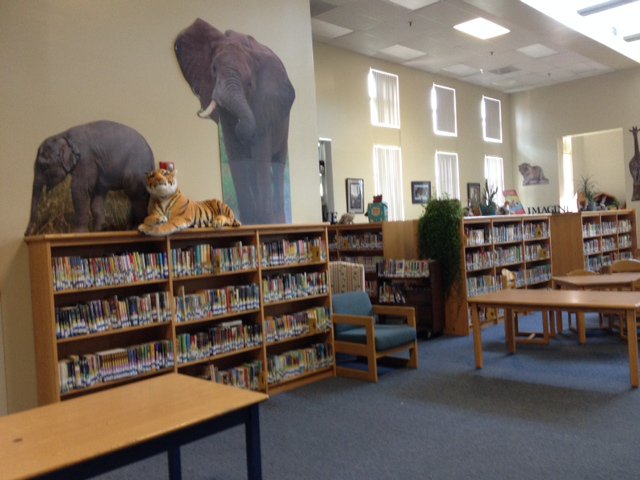
library photoI just heard from a student who is preparing to start her first year as an elementary school librarian.  She’s been working all summer to create a welcoming space for her students and she wanted to know if there were any resource books I might recommend for library lessons.  I remember wanting that book when I started out as well.  But I never found it because ultimately the best lessons are those that you create yourself for your unique context with your unique stamp of creativity.  And they are created in response to the needs of your students and teachers and discovered in a collaboration with the school community.

But where do you start?

Try to find out what’s happening in classrooms/grade levels so you aren’t teaching skills in a vacuum.  For example, I did a reading interest survey every year with 3rd grade but then presented the findings as large graphs that I used for lessons related to their math curriculum and then posted outside the library for everyone to see.  I usually asked teachers what they were doing in science or social studies because those were easy content to grab on to.  Then I might ask what they were teaching in reading or writing and find a way to integrate those with library resources/skills.  So when I learned that second grade was studying voting in social studies and using literature for writing models I introduced the  Jane Yolen, How Do Dinosaurs... series and we wrote a class book about “How Do Dinosaurs Vote?”

It helps if you have some theme that you pull through the lessons and the year.  So one year I was asked to focus on integrating math; another year the focus was science – in these cases the principal or the school improvement plan allowed me to see what was a schoolwide focus that I could work with.  Or decide that you will make this the year of poetry or the year of working with video and find ways to integrate those with as much content and lessons as possible.  Then you can stand up in a faculty meeting and say “This year the library focus will be on poetry and I invite you to plan lessons with me that integrate poetry.  I’m sure I can find a poem for anything you are teaching: math, science, social studies.  And you can expect to find poetry popping up in unusual places like the morning announcements, the cafeteria or the bus line.”  You’ve provided an invitation and a challenge.

What are teachers being told they need to do more of this year? — find out how you can help or even lead any initiative.  One year teachers were introduced to thinking maps so I was modeling those with every library lesson.  I attended any staff development required of my teachers and then tried to integrate what they were told to do in their classrooms with what I was doing in the library. When I was planning with teachers this willingness to support them in new initiatives was greatly appreciated.

Use what you have – this may seem obvious – but look around to see what kinds of resources are unique and underutilized – online databases, ebooks, whiteboard, old sewing machines, puppets, a collection of magazines…

One year I built my lessons around my state’s children’s book award list.  I noticed that a lot of the books had some relationship to math concepts and I was able to integrate literature with mathematics in collaborative lessons.  Then we were able to participate in voting for the award.

Today I would be looking around for lesson ideas on Pinterest or Livebinder and curating my own collection of ideas.  Find colleagues who are willing to share ideas and don’t be afraid, as one of my mentors told me to “beg, borrow and steal” ideas but combine them with local needs and resources to spin your own particular kind of magic.

Yolen, Jane (2000).  How do dinosaurs say goodnight?  Scholastic.    Find this book and others in the series at http://www.scholastic.com/titles/dinogoodnight/

Photo courtesy of Jessica Thompson (2014).

Time for Collaboration

clocks_1490The National Center on Time & Learning (NCTL)  conducts research, helps guide public policy, and provides technical assistance for “national, state and local initiatives that add significantly more school time for academic and enrichment opportunities to help children meet the demands of the 21st century.” In May, 2014, they published a report called “Time for Teachers: Leveraging Time to Strengthen Instruction and Empower Teachers.” You can access the executive summary or the full report.

The study involved 17 high-performing and rapidly improving schools across the U.S. that are involved in a movement to expand learning time. “The expanded school days and/or years also increase learning opportunities for teachers, who have more time to collaborate with their peers, master new content, plan for and reflect on lessons, and hone instructional practices.”

Three themes emerged from their study of teacher development: professional culture matters; teachers are leaders; and the school is the locus of learning.  If the school climate promotes professional growth, if teachers are empowered to lead through peer mentoring, coaching, and sharing expertise, and professional learning is embedded in practice, instructional practices will improve. “A successful teaching force spends time not only teaching, but also collaborating, planning, leading, and learning.”

Yes! To teacher leadership and job-embedded professional development as best practices to improve student learning.

Side Note: If you are looking for more real-world evidence, check out the article “Lessons from a school that scrapped a longer student day and made time for teachers.”  After experimenting with a longer school day for students, the principal of a Brennan-Rogers School in New Haven, Connecticut, found that extending collaboration time for teachers was more effective.

Works Cited

National Center on Time and Learning. “Time for Teachers: Leveraging Time to Strengthen Instruction and Empower Teachers.” Web. 1 Aug. 2014. <http://www.timeandlearning.org/files/Time%20for%20Teachers%20%28FINAL%29.pdf>

Peralta, Paola. Social Media Marketing. Digital Image. Licensed under Creative Commons Attribution-Share Alike 3.0 via Wikimedia Commons. Web. 1 Aug. 2014. <http://commons.wikimedia.org/wiki/File:Social_Media_Marketing.jpg#mediaviewer/File:Social_Media_Marketing.jpg>.

RoganJosh. Clocks_1490. Digital Image. Morguefile. Web. 1 Aug. 2014. <http://mrg.bz/Bnee4Q>.

Competition or Collaboration?

DSC02287

The recurring question in American education for the past 20 years has focused on how to improve learning outcomes for students.  The drumbeat of reform has been especially loud since NCLB (2001), the adoption of Common Core State Standards (2009), and the Race to the Top initiatives (2009).  In contrast to the competitive nature of these “reforms” that are determined through high stakes testing and punitive measures, ongoing educational research continues to document the impact of collaborative cultures that promote teaching and learning for student success in schools.

Educators in the field, and aspiring pre-service teachers should take heart from the evidence that shows that community and collaboration are key factors in student achievement.  Competition affords a false equivalency in education, and increases potential for failure for schools and students.

In this blog, we are committed to demonstrate how building collaborative cultures can be accomplished at the individual, local, district, state, and national level.  There are many challenges to impede progress, but we must continue to find the silver linings, and act on them!

I’d like to share two items (of the many) I read recently, about the benefit of collaborative cultures that are in the best interests of our wonderful students and talented educators.  Teachers know that working together is smarter and that students also need opportunities to learn collaboration skills for real life success.

Linda Darling-Hammond, Charles E. Ducommen Professor of Education at Stanford University and the Faculty Director of the Stanford Center for Opportunity Policy in Education recently described the results of the 2013 TALIS  survey (Teaching and Learning International Survey) which was conducted by the OECD (Organization for Economic Cooperation and Development) in schools throughout the world.  The focus of that survey was on teaching and learning, not on test scores of students.

In a June 30, 2014 Huffington Post article, “To Close the Achievement Gap, We need to Close the Teaching Gap,” she provided some insightful conclusions about the state of American education, from the perspective of teachers and how they are supported in their professional roles.  This should be required reading for educational policy makers and administrative leaders.    Among the results is the fact that in the United States, teachers work longer hours, and have less opportunity for feedback and collaboration with peers.  High performing countries on the PISA test use teacher collaboration as an indicator that leads to student success.  The equitable distribution of resources for education in other developed nations is another indicator for student success.   Disadvantaged students in the U.S. have fewer resources than comparable developed nations, particularly in large urban systems and other areas of poverty.  Read the post for her suggestions, and think about how we can use the results from this survey to raise awareness of inequitable educational policies in our own state and districts.  Here’s an opportunity for school librarians to stand with colleagues and community members to refocus the discussion about teaching and learning, and how to measure performance.

Justin Minkel, a second/third grade teacher in Arkansas pens a blog, Teaching for Triumph, and he was invited to lunch with three other teachers from high poverty districts to tell President Obama and Secretary of Education Arne Duncan about the challenges that they face in the classroom.  He has posted a report of that meeting, “What We Shared with Obama.”  In it he recalls the salient points that the teachers made about teaching and learning.  One of the key factors for success is the collaborative culture within their schools.  The three other points he also makes get to the heart of the commitment that teachers have for all their students, not just those who are destined for success.  Take time to read his blog and you will be inspired.  Let’s hope that the President and the Secretary were listening, and will think about supporting collaboration, not competition…


References:


Darling-Hammond, Linda.  “To Close the Achievement Gap, We Need to Close the Teaching Gap.”  Huffington Post (June 30, 2014). Weblog.  http://www.huffingtonpost.com/linda-darlinghammond/to-close-the-achievement_b_5542614.html

Minkel, Justin.  “What We Shared with Obama.”  Teaching for Triumph: Reflections of a 21st Century ELL Teacher(July 10, 2104). Weblog. http://blogs.edweek.org/teachers/teaching_for_triumph/2014/07/what_we_shared_with_obama.html


Image:

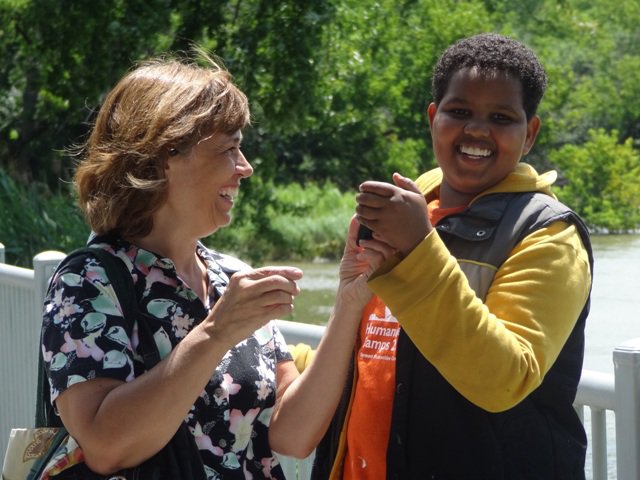
Judith Kaplan Collection: Carole Renca and friend-used with permission

Leading Through Technology PD

Last week Judi wrote about professional development stating: “Professional development that supports coteaching works. It creates opportunities for school librarians to positively impact student learning alongside classroom teachers. There is no better way for the skills and expertise of two or more educators to improve educators’ teaching and students’ learning” and she gave us a great example. Judi’s post and this recent post on Ed Tech Review – What Teachers Want More Than New Technologies? PD Opportunities to Learn to Use Them Effectively again have me thinking about the role of the school librarian in working with teachers to integrate technology. We are seeing this same theme over and over again in recent studies – that teachers need more training for using technology effectively.  This is a prime opportunity for school librarians!

And then yesterday AASL released a new mission statement The American Association of School Librarians empowers leaders to transform teaching and learning.  In discussing a new mission statement the chair said “three key components rose to the top” and one of these components is: “School librarians serve as the guiding light in transforming learning through new tools and technology.” Again we see this leadership role in technology integration emerging and I do think that most school librarians see themselves as leading in finding and learning about new technologies for learning. But what are you doing to transform learning through technology? Modeling through use in your own instruction is great, but part of transforming teaching and learning has to be teaching the teachers and I think we need to push to do more in our technology integration efforts and that is through providing professional development for the teachers.

Also this summer as I prepare for state and NCATE certification visits I have been revisiting and becoming even more familiar with the standards for preparing future school librarians. Both sets of these standards talk about the importance of teaching teachers through providing professional development and indeed I teach my students about this and they even have to create a professional development training session and present it to their classmates. So I know this is something school librarians know how to do and a way we can lead, but yet I hear more and more from school librarians that this is just simply not part of their job and that they are not recognized as someone who can provide professional development. So it makes me question why aren’t principals recognizing and taking advantage of school librarians as a free resource in their building to provide technology professional development for teachers who obviously desire it? And what can we do about this?

Summer “Time”

Tropical beach scene on a sunny day in Oahu, Hawaii

As a teacher or teacher librarian, how often have you heard, “Oh you are so lucky, you have the summer off!”?  Of course those are the folks who are on the outside looking in. Those of us in the trenches know otherwise.  Summer time is just a different wavelength for many in the field of education.  In fact, most teachers I have known, are juggling family time, recreational adventures, and personal professional learning in the few weeks between the wrap up for one school year in May or June, and the preparation for another that may start in the first weeks of August.  The idea that educators are basking in a long summer hiatus is a pipe dream.

Even in the reboot and recharge mode, teachers are thinking ahead to the challenges of a new set of students, and how to meet their individual needs. Time without required meetings, committees, and assessments is time to reflect on the big picture. What has been successful and what needs improvement?  That kind of time is precious during the crush of the school schedule, and summer provides an opportunity for R and R-and collaboration.  As teacher librarians we have to make those connections with our colleagues.

In a recent AASL Blog, Brooke Ahrens asks, “When is the best time?”  In her post, Let’s Get Together Thursday, (June 12, 2014)  she shares the experience of working with colleagues in her district in curriculum and program planning just after classes ended for the year.  As she says, working together beyond the constraints of standards and grades was refreshing, but mental fatigue influenced their progress. She wonders if August would be better, but realizes that time is problematic also.  Collaboration and input are important, but what are some possible alternatives to make it happen?

During my years as a teacher librarian, I found that July was a great month for collaborating informally with my colleagues.  I would sneak into school early a couple of mornings a week to get my book orders in, unpack books and supplies, or revamp a section of the collection. More often than not, a teacher friend would pop in to say hello. Then the conversation would segue to the upcoming school year and what the teacher wanted to accomplish, and how I could help. Without the pressure of a packed schedule, we could tease out projects that we could plan ahead.   Asynchronous collaboration through Google and other social media applications make planning that much easier now.

My school district offered summer incentives for curriculum planning, and I often participated as a resource person in science, social studies, and language arts.  College credit for curriculum work was available for participants. Laptops or other new devices were provided  for developing curriculum units integrating technology.  Stipends were offered for teacher leaders who trained others in a train the trainer model.  When I signed on to take part, I often found that other teachers saw me as a true colleague, and I felt part of the team. I understood their challenges, and they understood mine because we had a chance to have deep discussions and share expertise.  In mid summer, when most of the teachers had a few weeks to unwind, we found mental energy to be creative and innovative.  That energy and planning carried us through during the implementation of our ideas in the next school year and beyond.

So, in July, take advantage of the summer mind of your colleagues. It may be the best time for initiating collaboration.  Join a district summer work group if it is available. They usually only work for a week or so. See if any of your colleagues are lurking in their classrooms when you are at school, too.  Laugh, chat, and make a plan.  Send out some ideas for new books or resources via email, or your blog or website. Stay in touch through Twitter and Facebook.  Find a new application that you can share.  Screencast a tutorial or find one on YouTube.  Cultivate your garden of ideas and invite your friends to the harvest.


Happy summer!  And don’t forget your recreational reading!


References:

Ahrens, Brooke. (2014, June 12).  Let’s Get Together Thursday-What is the Best Time?  AASL Blog. (weblog) http://www.aasl.ala.org/aaslblog/?p=4688

Image: Microsoft ClipArt


Collaboration, Cooperation – Time for a Change

A recent blog post, Cooperation vs Collaboration, I read about a couple of weeks ago has been stuck in my head and I keep coming back to it and re-reading from the school librarian perspective. Of course coming from the school library world I instantly thought of Loertscher’s Taxonomies of the School Library Media Program (2000).

This post gives what I consider to be an up to date viewpoint on cooperation and collaboration:

“When collaborating, people work together (co-labor) on a single shared goal. Like an orchestra which follows a script everyone has agreed upon and each musician plays their part not for its own sake but to help make something bigger.

When cooperating, people perform together (co-operate) while working on selfish yet common goals. The logic here is If you help me I’ll help you” and it allows for the spontaneous kind of participation that fuels peer-to-peer systems and distributed networks. If an orchestra is the sound of collaboration, then a drum circle is the sound of cooperation.”

The rest of the post goes on to talk about differences in the two and how they can be thought of in the context of today’s world  – very interesting reading! As I read I was reminded of my own research and distributed leadership. Distributed leadership places an emphasis upon maximizing expertise of teachers and building capacity within the organization (Spillane, Diamond, Burch, Hallett, Jita, & Zoltners, 2002).  Distributed leadership can provide leadership that is “fluid and emergent, rather than a fixed phenomenon” (Gronn, 2000, p. 324), where teachers can become leaders at various times and work collaboratively to pool their expertise, vertically and laterally (Muijs & Harris, 2007).  This type of leadership is particularly appropriate for school librarians due to their knowledge of pedagogical principles, their global perspective on the school curriculum, their training as information experts, and their experience in collaborating with classroom teachers.  School librarians have this unique expertise to contribute.

So indeed the school librarian is there to play a part and through their strengths contribute to the bigger goal of academic achievement. But from experience I also know that there is this spontaneous participation that comes with being a school librarian and indeed we “perform” together with teachers while working on common goals with teachers, but we are also working on our goals focusing on creating information literate students.

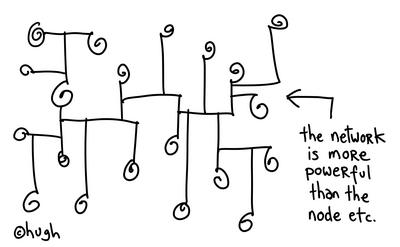
This post goes on to further talk about the shift to connectives and connectivism, which I think definitely relates to school librarians and I teach in my courses. “Connectives cooperate. A connective doesn’t give priority to the group or the individual but instead supports and encourages both simultaneously… By linking selfish yet common acts together, connectives are able to empower individuals while creating new kinds of group value.” Using the example of Delicious and individual bookmarks here really brings home the point that connectivessupport individuals while encouraging the emergence of new kinds of group value.”

Thoughts from this blog post such as “But today, cooperation is fueling most of the disruptive innovations of our time. In virtually every aspect of our culture, the old guard is being replaced by cooperative, self organizing, distributed systems” make me wonder if it is time that we as school librarians thought about our roles in this context.

Perhaps it is time for a change in our thinking – away from the old taxonomies, definitions, and terminology- to taking a new up dated look at what practice looks like in today’s school libraries.

http://gapingvoid.com/2007/04/09/the-network/

The Network: http://gapingvoid.com/2007/04/09/the-network/

References

Cloudhead. (2014, June 2). Cooperation vs collaboration [Web log post]. Retrieved from http://cloudhead.headmine.net/post/3279118157/cooperation-vs-collaboration

Gronn, P. (2000). Distributed properties: A new architecture for leadership. Educational Management & Administration, 28(3), 317-38.

Johnston, M. P. (2012). School librarians as technology integration leaders: Enablers and barriers to leadership enactment. School Library Research, 15(1). Retrieved from www.ala.org/aasl/slr

Loertscher, D. V. (2000). Taxonomies of the School Library Media Program (2nd ed.). Clearfield, UT: LMC Source.

Muijs, D., & Harris, A. (2007). Teacher leadership in (in)action: Three cases studies of contrasting schools. Educational Management Administration & Leadership, 35(1), 111-134.

Spillane, J. P., Diamond, J. B., Burch, P., Hallett, T., Jita, L., & Zoltners, J. (2002). Managing in the middle: School leaders and the enactment of accountability policy. Educational Policy, 16(5), 731-762.


Big Questions Need Answers

I see you

On April 5, 2014 Education Quality Standards were adopted by the Legislative Rules Committee of the Vermont Legislature. You may ask, “What does that have to do with me, or collaboration-the theme of this blog?”  The bigger question is, “In my state, are there administrative guidelines for establishing school library programs led by certified school librarians that support state education statues?”  The answer to this question varies across the country. You may be surprised when you start to do some digging. What’s happening in your neck of the woods? How can you find out?

 A year ago, the draft document for Vermont State Board of Education, Education Quality Standards (EQS), omitted any language that pertained to school libraries, or certified professional teacher librarians.  That’s when the collaborative team of volunteers from the Vermont School Library Association (VSLA) went into action mode.  Last September in this blog, I posted some details about our plan to insert appropriate language into the document.  It has taken time to work through the whole process, but we are delighted that our collaborative efforts have made a difference.  Now public school districts using the EQS to meet  state law requirements have guidelines for school library programs and staffing that are embedded within the big picture of educational programs and services in Vermont.  The document itself reinforces a commitment to equitable student centered learning, and is quite progressive.

The takeaway from our experience highlights the power of collaboration, and the need for continued advocacy at many different levels.  We have to be able to show and tell the value of a school library program for students.  Recently on this blog, we  have been focusing on ideas for collaboration, not only with our co-teachers, but also with our principals.  The grassroots approach builds influence, acceptance, and support for our programs and our positions.

 In Vermont, we have been asking the question, “Does your principal know what you do-really know and understand the complexities of your job?”  Heidi Huestis, Professional Concerns Chair of VSLA, and I  conducted a short survey of members to get a picture of existing job descriptions and evaluation systems in schools across the state.  The results, based on responses from almost 40% of active members have led us to ask more questions.  We will use this information and future surveys and other research to plan for advocacy as an organization.

 Earlier this month, we presented the findings from the survey at the Dynamic Landscapes Conference at Champlain College in Burlington, Vermont.  Our presentation was titled-Under the Radar: Teacher Librarian Job Descriptions and Evaluations, and here’s a link to the slides, and the full survey is included on the resources page.  We were especially pleased that Joyce Valenza, one of the keynote speakers at the conference, was there to share some ideas, too.

 Job descriptions and evaluations are opportunities for starting conversations with principals and administrators.  If you don’t have either, or if they are not updated, you are under the radar- not a good thing!  If important stakeholders don’t know what you do, you are wearing an invisibility cloak.  As Susan Ballard and others have said, “If you are not at the table, you may be on the menu.”

 Resources:

Dynamic Landscapes, May 16, 2014-Under the Radar: Teacher Librarians Job Descriptions and Evaluations https://docs.google.com/presentation/d/10BPsnIZC86WY17Bqodv3YHnEbXnaneZsRvZESkDccoA/edit#slide=id.g33504c028_034

Education Quality Standards, Vermont State Board of Education (Sections on staff and resources, 2121.2, 2121.3 and 2121.4) http://education.vermont.gov/state-board/rules/2000

Image: Microsoft Clipart


Thoughts on Student Collaboration

As the semester comes to an end and I reflect on my own courses of the past year, several themes emerged. One being student collaboration and if I as an instructor am incorporating enough student collaboration into my courses. Because how better to teach future school librarians to work with others, which is a vital part of our job, than integrating group work into their preparation.

I strongly believe that learning is social and is “enhanced by opportunities to share and learn with others” (AASL, 2007) and I am always encouraging my students to share in class. While they are often reluctant, because it is a risk to put yourself out there, I always hear at the end of the semester what a valuable learning experience it was to hear people share their various viewpoints and experiences.

This led me to thinking about student collaboration in the school library and how are school librarians fostering learning in a social context. Student collaboration is an important part of inquiry-based teaching. Through working together students develop verbal communication skills, compromising skills, team work skills, and benefit from each others strengths (Kuhlthau, Maniotes, & Caspari, 2012).

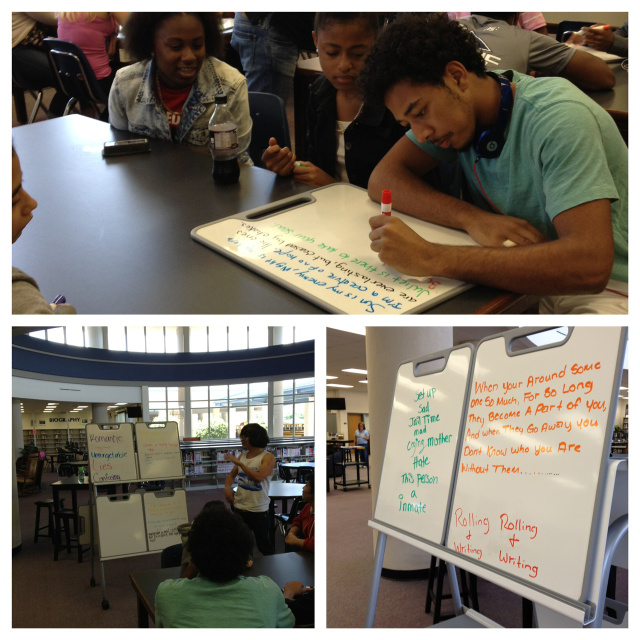
In relation to instruction, “inquiry occurs within a social context” (Kuhlthau, Maniotes, & Caspari, 2012, p. 38) and students collaborating throughout the inquiry process allows students to hear about and learn from a variety of viewpoints. This post from last week What Happens When 5th Graders Run the Classroom: A SOLE in Action provided a great example and one student comments “I like how we get to be independent and collaborate with our friends and talk it out instead of the teacher teaching us” (para. 6). Another example that I saw this past week was from The Unquiet Librarian blog where students collaborated to create poems as an end of the year reflective response. Students were so engaged they even created a hashtag #rollingandwriting – check out the pictures and videos to see this great project in action!

This posting also brings to mind another important factor in encouraging student collaboration in the school library – the facilities. Just having the space setup in a way that is conducive to student collaboration plays an important part in encouraging working together and social interaction. Note the mention of the new furniture and rolling easels and the students’ excitement over it and they way it facilitated collaborating. And another aspect is technology and we are lucky enough to have a variety of tools that even make working together easier and more convenient for our students.

The AASL Standards for the 21st Century Learner (2007) promote teaching students to share their knowledge, to “collaborate as members of a social and intellectual network of learners,” and “demonstrate teamwork by working productively with others” (p. 5). As school librarians we are always very concerned about collaborating with teachers, but we must also remember the social aspect of learning and to facilitate this for our students.

http://theunquietlibrarian.wordpress.com/2014/05/09/rolling-and-writing-collaborative-poetry-with-verb-whiteboards/

http://theunquietlibrarian.wordpress.com/2014/05/09/rolling-and-writing-collaborative-poetry-with-verb-whiteboards/

References

American Association of School Librarians. (2007). AASL Standards for the 21st Century Learner. Chicago, IL: ALA.

Hamilton. B. (2014). Rolling and writing: Collaborative poetry with whiteboards. Retrieved from http://theunquietlibrarian.wordpress.com/2014/05/09/rolling-and-writing-collaborative-poetry-with-verb-whiteboards/

Kuhlthau, C. C., Maniotes, L. K., & Caspari, A. K. (2012). Guided inquiry design: A framework for inquiry in you school. Santa Barbara, CA: ABC-CIO LLC.

Scripture, N. (2014). What Happens When 5th Graders Run the Classroom: A SOLE in Action. Retrieved from http://blog.ted.com/2014/05/10/a-sole-in-action/