Coteaching Is the Answer…

jm_toondoo_sizedI subscribe to the Teaching Channel email blast. I especially appreciate the real-time video productions posted there, especially since I am no longer serving in a school and do not work with pre-K-12 teachers and librarians on a daily basis. This recently posted video shows an instructional coach working with a classroom teacher.

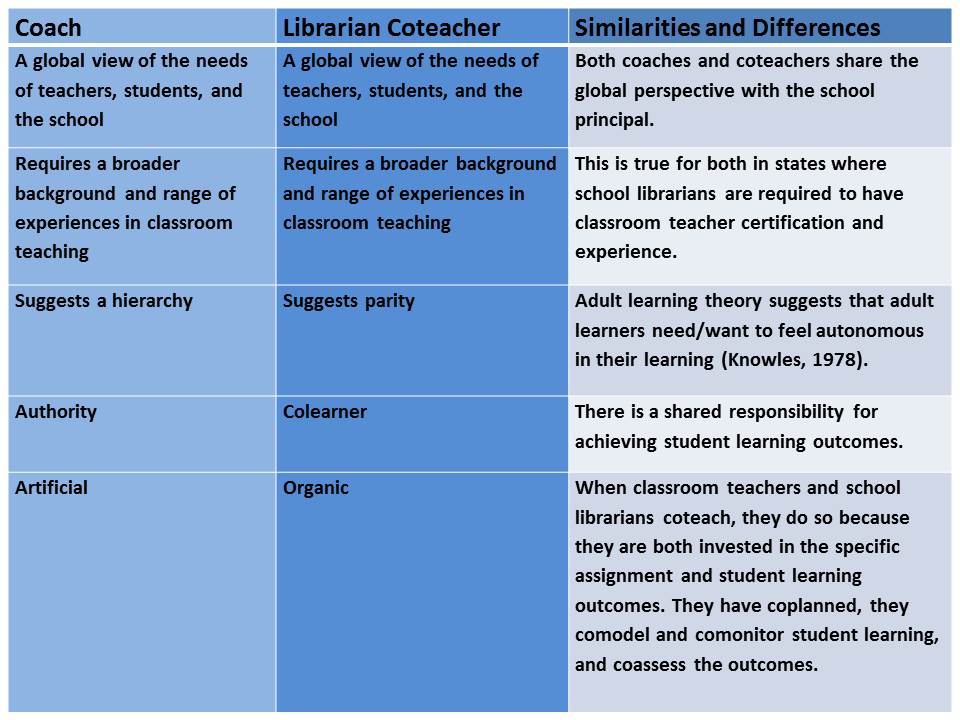
When I viewed this video, I thought of the differences between coaches and coteachers (as suggested in the chart in a previous post this week).

Although I don’t have a series of comparison videos for coteachers working with pre-K students, I do have a series of YouTube-hosted videos taken during a demonstration lesson for an undergraduate teacher preparation program course at Texas Woman’s University in Fall 2012. These videos show how classroom teacher-school librarian coteaching can be enacted through coplanning, comodeling, comonitoring, and coteaching.

I hope viewers will note the differences for the educators as well for the students. My experience, supported by research in the field, suggests that 21st-century school librarians who practice the instructional partner role are uniquely positioned to elevate teaching and positively impact learning in their schools.

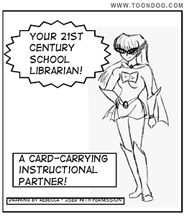
A Word about the Cartoon: Several years ago when I served in my first high school library, I started a graphic novel collection. These books were NEVER on the shelves, particularly during lunch when the Anime/Manga Club met to read, talk, and draw. This illustration, inspired by this genre, was drawn by Becca, a founding member of that club. I’d like to think that my super-hero work as an instructional partner had a part in inspiring her artwork as well.

References

Cartoon created at ToonDoo.com
Illustration by Becca – Used with Permission
Moreillon, J., & Hall, R. N. (2013). LS3013: Classroom-Library Collaboration Videos. http://tinyurl.com/clcvideos
Teaching Channel. (2013). Value of Instructional Coaching. http://tinyurl.com/tcvalueic

Coteaching or Coaching: That is the question…

school-news-colorAccording to an article in the Daily Freeman, Kingston, New York spent $750K to hire five elementary and two middle school literacy coaches. When I read the article about how these coaches help facilitate literacy across the curriculum, motivate students through research centers, and provide job-embedded professional development to teachers, I wondered why school librarians aren’t being used in this capacity.

In the past ten years, while there has been a decline in the number of school librarians, there has been an increase in “coaching” positions such as instructional, literacy, reading, and technology coaches or integration specialists.

I served as a literacy coach for one year. I had been a successful coteacher as a school librarian prior to taking that position. I erroneously thought I could make a greater impact on instruction through an “authoritative” role; the teachers had to work with me. I returned to school librarianship the following year because, in my experience, coteaching was more effective than coaching, most notably in terms of the impact on adult learning—mine and that of my classroom teacher colleagues.

From where I sit on the “library team,” maximizing the school librarians’ impact through “coteaching” has several advantages over “coaching.”

coach_coteacher_table

What is your experience?

References

Hicks, M. A.. “School News.” Clip art licensed from the Clip Art Gallery on DiscoverySchool.com.

Knowles, M. (1978). The adult learner: A neglected species. (2nd ed.). Boston: Gulf.


STEM + Inquiry=Collaboration

00439573Sue Kimmel posted recently about finding ways to connect and collaborate with teachers using the Common Core Math Standards and literacy. This week I want to encourage reaching out to make connections around science initiatives, too, by looking at citizen science.

Citizen scientists ignite a passion for science and inquiry through participation in authentic projects that actively make a difference in scientific knowledge on large and small scales.  With the current emphasis on science, technology, engineering, and mathematics (STEM) in many school districts across the nation, the citizen scientist collaborative model for collective inquiry, gathering and analyzing data, and problem solving can be used to generate enthusiasm and curiosity in science classrooms.

Here is an opportunity for teacher librarians to become acquainted with the Common Core ELA Science Standards 6-12, and the Next Generation Science Standards, and to bring some fresh ideas and resources for developing curriculum units with other classroom teachers.

As an instructional partner, and co-teacher, we have to continue to build our teaching toolkit with pedagogy and content knowledge.  For students to become citizen scientists in their schools and communities, teacher librarians and teachers collaborate to design meaningful learning opportunities that engage curious minds, require action and reflection, and help solve real world problems.     Or, you could also get your students interested in a citizen science club that could have a physical and virtual presence in your library media center!

What is “citizen science?” you might ask.  How does technology play role in the collective capacity of amateur scientists all over the world, or in your own community? How can you develop a unit of study that replicates or enjoins some of the authentic work that is done by citizen scientists?

Here are a few ideas to get the ball rolling with both teachers and students:

Recommended reading:

  • Citizen Scientists by Loree Griffin Burns presents an approachable overview about the impact of citizen science for young people.  It’s a great introduction to some of the current projects around the world and shows how global citizenship is enhanced by making connections and contributions by individuals.  As an example of narrative non-fiction, is can also serve as a model for Common Core Reading and Writing Standards.

Edutopia website has a couple of related blog posts:

Youtube videos that present examples of authentic science inquiry:

  • “Digital Fishing on Citizen Science Cruise,” shares the educational program of the Crystal Cove Alliance in Newport Beach (CA) that immerses Students in the science of marine protected area management.http://www.youtube.com /watch?v=u6m2tqZMD3s
  • “Technology creates Citizen Scientists” relates the critical role that technology plays in allowing citizen scientists to help solve real world problems at local and global levels. http://www.youtube.com/watch?v=81hhecI0p5k

Websites:

  • “Scistarter: Science We Can Do Together” offers many projects and ideas for scientific inquiry and citizen scientists. http://www.scistarter.com/

Calling All Citizen Scientists!

I’m sure there are many opportunities in your local school and community for getting your student citizen scientists involved in helping to solve problems.  Catch the STEM wave that is a natural fit for your library program!


References:

Burns, Loree Griffin (2012). Citizen scientists. NY: Square Fish. http://us.macmillan.com/citizenscientists/LoreeGriffinBurns

Brunsell, Eric. (2010). A primer on citizen science.  Edutopia (2010, Oct.13). Weblog.  Retrieved from: http://www.edutopia.org/blog/citizen-science-eric-brunsell.  .

Common core Initiative: English Language Arts:  Science and Technical Standards (2011). Website.  Retrieved from: http://www.corestandards.org/ELA-Literacy/RST/9-10. .

Digital fishing on citizen science cruise. (2012, Sep. 25)  Newport Beach, CA: Crystal Cove Alliance. Video.  Retrieved from: http://www.youtube.com/watch?v=u6m2tqZMD3s.

Next Generation Science Standards. (2013). Website.  Retrieved from: http://www.nextgenscience.org/.

Phillips, Mark. (2013, April 17). Teaching and the environmental crisis: resources and models. Edutopia . Weblog.  Retrieved from: http://www.edutopia.org/blog/teaching-environmental-crisis-resources-models-mark-phillips.

Scientific American: Citizen Science. Website.  Retrieved from:  http://www.scientificamerican.com/citizen-science/.

Scistarter. Website.  Retrieved from: http://www.scistarter.com/.

Technology creates Citizen Scientists. (2012, Aug. 16) California Academy of Science.  Video.  Retrieved from: http://www.youtube.com/watch?v=81hhecI0p5k.

This thing called science part 6: Citizen science.  (2013, May 23). TechNyouvids. Video.  Retrieved from: http://www.youtube.com/watch?v=N6eN3Pll4U8.

Microsift clipart.


Leadership and Collaboration

1301014184_3786e4d2b8_mducks

As co-teachers and instructional partners, school librarians focus on collaborative opportunities with individual or teams of educators within a school community.  Many school districts have been providing professional development for educators by establishing Professional Learning Communities (PLC).   The PLC is a vehicle for collaborative planning and decision making that focuses on improving student learning.  To be successful participants, educators need training to understand the process for and commitment to collaboration that builds the collective capacity of a school system.  An effective PLC can change attitudes and transform teaching and learning in a powerful way.

School librarians are positioned to take leadership roles in PLCs, and should advocate for a place at the table.  Having honed a variety of collaboration skills of various levels, school librarians are familiar with setting goals, timelines, assessments, formulating projects, and are adept at analyzing data.  There are many configurations for PLC teams, and the school librarian should have a pivotal role in content areas.  Unfortunately, in many districts, the PLC teams may not integrate the school librarian into content or grade level groups.  Many times the PLCs are set to meet during the scheduled time for a class visit to the library/media center when the librarian is expected to supervise the class.  That prevents meaningful participation, and limits the expertise and knowledge that the librarian can share with the group.

Stepping into a leadership role means that the school librarian needs to be proactive and stay ahead of the curve.  Find out what is happening in your district or school.  What are the initiatives?  What are the goals for educators and student learning?  What curriculum changes are proposed?  Be ready to explain to administrators, teachers, parents, community members, and students how the school library program and resources will benefit the transformation of learning.  You are the expert, the information specialist, and can facilitate learning for all stakeholders.

If you want to realize your own capacity as an educational leader, I recommend two readings that have influenced my thinking recently.  One was an article in May/June 2013 issue of Knowledge Quest, “The Make-Good Mission.”  Michael Edson, the Smithsonian’s director of web and new media strategy, talks about the possibilities for the school library as a place for meeting the challenges of “scope, scale, and speed” presented by information in present day.  We simply can’t continue to do things the way we have done them in the past.  Organizations have to change from within, not top down.  We all have the capacity to contribute, not just receive information.

Change from within is one of the messages also in Leaders of Learning: How District, School, and Classroom Leaders Improve Student Achievement (DuFour and Marzano, 2011).  Two leaders in organizational systems and education explore how change and transformation can come about using the collective expertise of all stakeholders.  DuFour shares how PLC teams that are created and supported by district administrators and principals, can bring about improvements in student learning.  The training and support is imperative to make a successful outcome for all.  Collaboration skills have to be learned and the authors offer a blueprint.  Marzano clarifies how to establish what is important for students to learn and how to assess their learning.

At the AASL Conference in November 2013,  there will be sessions that focus on leadership roles and require specific collaboration skills.  Come to conference and gather more ideas to add to your leadership/advocacy tool kit!

Resources:

DuFour, Richard and Robert Marzano. 2011. Leaders of learning: How district, school, and classroom leaders improve student achievement. Bloomington, IN: Solution Tree Press.

Edson, Michael.  2013. The Make-good mission: Evaluating and embracing new possibilities for discovery and innovation in school libraries.  Knowledge Quest 41 (5): 12-18.

Photo: Microsoft clipart


Cross Pollination of Ideas and Understandings

Spring is finally emerging here in the North Country, and the bees are buzzing, birds are singing. Melissa’s post last week about encouraging partnerships with public and other libraries had me thinking about collaboration as a cross pollination of ideas and understandings. When school librarians have a chance to meet and work with others in the field whose overall mission is the same, but different according to parameters of their workplaces, the benefits move both ways.

Earlier in the year, I was invited to present at the New England Association of Independent School Librarians at their annual meeting on April 12, 2013. While I was excited to take on the task, I realized that I really had limited first-hand knowledge of independent schools, and I was eager to learn more. My background includes many years in the public school system and in a public university, so I did a bit of digging to understand my audience. What I found is that there is a range of independent schools for students of all ages, from those that are focused on college prep, to those that provide a niche environment for learning depending on the interests and abilities of the student. While independent schools are governed by a board of trustees, some are combinations of private/public schools, some are based on religious or organizational affiliation, and many are funded exclusively by tuition, donors, and endowments. They include day schools and boarding schools and are not for profit, and are not encumbered or constrained by public school regulations.

Libraries are an important part of the school experience in independent schools, and are often extolled as indicators of the quality of the school. The National Association of Independent Schools has established Guidelines of Professional Practice for Librarians, and there are many regional independent school library organizations.  There is a separate section within the American Association for School Librarians (AASL) for Independent Schools (ISS), and therefore, independent school librarians have access to professional networks that meet their particular concerns, which are not so different than those of public school librarians.

The April NEAISL meeting was held at Burr and Burton Academy in Manchester, Vermont, and attendees came from across New England and upper New York State, in spite of the snow, sleet and freezing rain that is typical of early spring in Vermont.  Susan Ballard, AASL President, was the keynote speaker who suggested ways to advocate for school libraries through marketing or branding, a topic that resonates with all school librarians.  Throughout the day, in formal sessions and informal discussion, I listened for the common themes that connected independent school librarians. Enthusiastic about their work and their schools, they voiced familiar concerns about:

  • Effective technology integration
  • Engaging digital native students in learning
  • Advocacy
  • Changing space needs for libraries-learning commons
  • Diversity or lack of diversity in student populations
  • Collaboration with other faculty
  • Students with special needs or ELL
  • AP courses-yes or no
  • College research ready

While I did not hear very much about Common Core Standards, I must admit, it was a relief not to have that on the table.  As I listened and learned from independent school librarians, I realized more than ever, that dedication to library service for students and staff is the common denominator for all of us in the profession.  No matter where we work,   in urban or rural areas, in large or small public or independent schools, we are all committed to our mission, and we have a lot to share. I want to thank Merlyn Miller, Library Director at Burr and Burton for the opportunity to share, listen, and learn with such a diverse group of professional school librarians.

In order to take advantage of cross pollination of understandings, I urge you to seek out your fellow school librarians to compare notes and ideas. If you are in a public school, plan to visit a local independent school.  If you are in an independent school, locate a nearby public school.  There is a lot to learn from different perspectives, and enjoy your visit!

References:

American Association of School Librarians Independent Schools Section. Online. http://www.ala.org/aasl/aboutaasl/aaslcommunity/aaslsections/iss/iss .

Conference program for New England Association of Independent School Librarians. Online. https://sites.google.com/a/burrburton.org/new-england-association-of-independent-school-librarians-conference-2013/conference-program.

Guidelines of professional practice for school librarians. National Association of Independent Schools. Online. http://www.nais.org/Series/Pages/NAIS-Guidelines-of-Professional-Practice-for-Librarians.aspx. .

Hand, D. Independent school libraries: Perspectives on excellence. (2010). Santa Barbara, CA: Libraries Unlimited.

National Association of Independent Schools. Online. http://www.nais.org/Articles/Pages/About-NAIS.aspx?src=utility.

Cross Pollination of Ideas and Understandings

Spring is finally emerging here in the North Country, and the bees are buzzing, birds are singing. Melissa’s post last week about encouraging partnerships with public and other libraries had me thinking about collaboration as a cross pollination of ideas and understandings. When school librarians have a chance to meet and work with others in the field whose overall mission is the same, but different according to parameters of their workplaces, the benefits move both ways.

Earlier in the year, I was invited to present at the New England Association of Independent School Librarians at their annual meeting on April 12, 2013. While I was excited to take on the task, I realized that I really had limited first-hand knowledge of independent schools, and I was eager to learn more. My background includes many years in the public school system and in a public university, so I did a bit of digging to understand my audience. What I found is that there is a range of independent schools for students of all ages, from those that are focused on college prep, to those that provide a niche environment for learning depending on the interests and abilities of the student. While independent schools are governed by a board of trustees, some are combinations of private/public schools, some are based on religious or organizational affiliation, and many are funded exclusively by tuition, donors, and endowments. They include day schools and boarding schools and are not for profit, and are not encumbered or constrained by public school regulations.

Libraries are an important part of the school experience in independent schools, and are often extolled as indicators of the quality of the school. The National Association of Independent Schools has established Guidelines of Professional Practice for Librarians, and there are many regional independent school library organizations.  There is a separate section within the American Association for School Librarians (AASL) for Independent Schools (ISS), and therefore, independent school librarians have access to professional networks that meet their particular concerns, which are not so different than those of public school librarians.

The April NEAISL meeting was held at Burr and Burton Academy in Manchester, Vermont, and attendees came from across New England and upper New York State, in spite of the snow, sleet and freezing rain that is typical of early spring in Vermont.  Susan Ballard, AASL President, was the keynote speaker who suggested ways to advocate for school libraries through marketing or branding, a topic that resonates with all school librarians.  Throughout the day, in formal sessions and informal discussion, I listened for the common themes that connected independent school librarians. Enthusiastic about their work and their schools, they voiced familiar concerns about:

  • Effective technology integration
  • Engaging digital native students in learning
  • Advocacy
  • Changing space needs for libraries-learning commons
  • Diversity or lack of diversity in student populations
  • Collaboration with other faculty
  • Students with special needs or ELL
  • AP courses-yes or no
  • College research ready

While I did not hear very much about Common Core Standards, I must admit, it was a relief not to have that on the table.  As I listened and learned from independent school librarians, I realized more than ever, that dedication to library service for students and staff is the common denominator for all of us in the profession.  No matter where we work,   in urban or rural areas, in large or small public or independent schools, we are all committed to our mission, and we have a lot to share. I want to thank Merlyn Miller, Library Director at Burr and Burton for the opportunity to share, listen, and learn with such a diverse group of professional school librarians.

In order to take advantage of cross pollination of understandings, I urge you to seek out your fellow school librarians to compare notes and ideas. If you are in a public school, plan to visit a local independent school.  If you are in an independent school, locate a nearby public school.  There is a lot to learn from different perspectives, and enjoy your visit!

References:

American Association of School Librarians Independent Schools Section. Online. http://www.ala.org/aasl/aboutaasl/aaslcommunity/aaslsections/iss/iss .

Conference program for New England Association of Independent School Librarians. Online. https://sites.google.com/a/burrburton.org/new-england-association-of-independent-school-librarians-conference-2013/conference-program.

Guidelines of professional practice for school librarians. National Association of Independent Schools. Online. http://www.nais.org/Series/Pages/NAIS-Guidelines-of-Professional-Practice-for-Librarians.aspx. .

Hand, D. Independent school libraries: Perspectives on excellence. (2010). Santa Barbara, CA: Libraries Unlimited.

National Association of Independent Schools. Online. http://www.nais.org/Articles/Pages/About-NAIS.aspx?src=utility.

School Structures that Support Collaborative Cultures, Part 2

Shared collaborative planning time is another school structure that supports educators in building and sustaining a culture of collaboration. In schools and districts where administrators recognize this as an essential component of effective instruction, grade-level, classroom-library, and interdisciplinary collaboration is more likely to be practiced and lead to positive results in terms of improvements in student learning and educator proficiency.

The National Center for Literacy Education (NCLE) is a coalition of education associations, policy organizations, and foundations united to support schools in elevating literacy learning. The American Association of School Librarians is a partner organization. NCLE conducted a national survey of educators in all roles, at all grade levels, and in all subject areas to find out more about what is actually happening in schools. (Note: This report was funded by the Ball Foundation.)

Today, the Literacy in Learning Exchange released the findings: “NCLE Report: Remodeling Literacy Learning.”

The report states that although “working together is working smarter, schools are not structured to facilitate educators working together.” It also noted that “effective collaboration needs systemic support.”

Here’s a recommendation that all educational decision-makers should note: “Embed the collaboration of educators in the school day. This is critical for deep student learning and is a necessary prerequisite to the success of other school reforms.”

Schools can start by instituting shared planning time during the school day and focus on collaborative job-embedded professional development. The recommendations would go a long way to building the necessary school structures to help make professional learning communities successful. I encourage every educator to make time to read this report.

Works Cited

Innovations Lightbulb. Digital image. HHS.gov. U.S. Department of Health and Human Services. Retrieved from http://www.hhs.gov/open/initiatives/innovationfellows/index.html

National Center for Literacy Education. “NCLE Report: Remodeling Literacy Learning.” Retrieved from http://www.literacyinlearningexchange.org/remodeling

Teaching Teachers Technology

To further this concept of leadership in technology integration, I hope that Building a Culture of Collaboration Blog school librarian readers will consider the importance of their approaches to teaching teachers technology. While our ultimate goal is to get digital tools in the hands of students so they can use them for accessing information and planning presentations, and producing knowledge, working with classroom teachers and specialists is the way to ensure school-wide technology integration.

On Thursday, February 6th, I will deliver the Library/Media Specialist Academy Keynote at the Texas Computer Education Association Conference in Austin. You can access the online support for my presentation “Teaching Teachers Technology: The School Librarian’s Starring Role.”

When we consider that every time a school librarian or technology integrator facilitates a classroom teacher’s integration of technology tools, we are impacting the learning of every student in that educator’s classroom this year and most likely for years to come. It is important then that we learn effective strategies for teaching teachers. Theories related to andragogy, the science of teaching adult learners, were brought to the U.S. by Malcolm Knowles. This is my summary of his ideas about adult learners.

Adult learners:
1.    are self-directed and take responsibility for their own learning.
2.    have prior experience that can be a positive or negative influence on learning.
3.    are motivated by an internal need to know.
4.    have a problem-solving orientation to learning.

What instructional problems can we help classroom teachers solve in order to effectively integrate technology tools into learning and teaching in our schools?

References

Knowles, M. The adult  learner: A neglected species. (2nd ed.). Boston: Gulf.

Word Cloud created at Wordle.net

The Role of Tempered Radicals in a Culture of Collaboration

I have really been encouraged by Judi’s posts regarding what pre-service principals saw as the benefits to students and the benefits to educators of the school librarian as a collaborative partner with teachers.  I was particularly struck by the observation that lessons co-planned, co-taught, and co-assessed with the school librarian “pushed instruction to a higher level” and provided the kinds of targeted, formative assessment essential to an evidence-based practice.  The school librarian holds a pivotal position in a school’s learning culture. He or she works within the school structure to nudge instruction, assessment, and ultimately student learning to a higher quality. This type of “embedded professional development” works at a subtle, but powerful level to fundamentally change the culture of a school into a learning community.
School librarians serve in a role that might be characterized as that of “tempered radicals,” a phrase introduced by Stephanie Meyerson (2001)and recently revisited by Peter DeWitt in an Education Week blog post entitled “Education needs more tempered radicals.” Tempered radicals are those who work within the system to create small but potentially pervasive changes to the system.  Working within the system, they retain their legitimacy as an insider, yet introduce difference and provoke learning.  As Dewitt suggests:

Tempered radicals are those educators on the inside who make subtle changes every day. Whether it’s the way they educate students (i.e. seamlessly using technology, parent communication, grading, etc.) or how they make changes to a building through shared decision making and listening to the needs of their stakeholders. Perhaps it is a principal who gives their teachers more autonomy or someone who sends out researched based articles on instruction and discusses them at faculty meetings so they can make changes in instructional practices.

Sound familiar?  School librarians are in an ideal position to serve as tempered radicals since they are recognized as members of the school staff by teachers and administrators, yet their work allows them to be in spaces of influence throughout the school as they plan with classroom teachers, converse with administrators and parents, and interact daily with students.  Meyerson suggests a tempered radical “brings an entirely new set of perspectives, asks different questions, and might pose different solutions to problems” (p.17).  School librarians are tempered radicals who create a climate of inquiry for administrators and teachers to “bounce ideas off of” leading toward an “evidence-based practice” focused on student learning.
Schools should be learning organizations where all members of the community value and engage in continuous learning.  School librarians embedded in the fabric of the community as they co-plan, co-teach, and co-assess instruction and learning are essential catalysts for the kinds of inquiry into practice that lead the learning of both educators and those they educate.  Inquiry offers a tempered approach to change because it raises essential questions and invites others to join in an exploration of answers.  It’s invitational, tempered, and relational. Collaboration and inquiry are essential partners in school reform and the goal of becoming a learning culture.

References

DeWitt, Peter (Dec. 13, 2012).  Education needs more tempered radicals [web log post]. Retrieved from http://blogs.edweek.org/edweek/finding_common_ground/2012/12/education_needs_more_tempered_radicals.html

Meyerson, Stephanie (2001).  Tempered radicals: How people use difference to inspire change at work.  Boston: Harvard Business School Press.

Collaboration: Benefits to Students

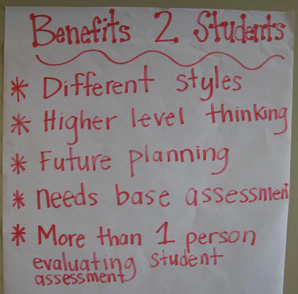
While observing the one-hour workshop cooperation and a collaboration planning session role play, the preservice principals in the TWU Professional Development and Supervision course identified the items (on the post-it pictured) as benefits to students.

The principals noticed that students would benefit from instruction provided by two (or more) educators with different teaching styles. When the preservice principals shared this bullet, they also talked about how the instruction that was planned addressed students’ various learning styles as well.

They noticed that through collaboration the educators pushed the instruction to a higher level. Critical thinking was a focus of the lesson/unit planned. The collaborative planning session revised a previously taught Civil War unit that focused on heroes and battles (what David Loertscher calls a “bird unit”) and involved students in an inquiry process in which they would develop personally-meaningful questions about the war.

Targeted assessment and shared responsibility for assessing the learning outcomes were also important to these preservice principals. School librarians can excel in gathering locally-generated formative assessment data to demonstrate the impact of instruction on student learning outcomes. This aspect of evidence-based practice is essential in today’s learning and teaching environment.

I want to thank the students in Dr. Starrett’s ELDR 5223 Professional Development and Supervision Fall ’12 class for allowing me to share the “library story” and for sharing their insights with me/us.


Reference

Loertscher, David V., Carol Koechlin, and Sandy Zwaan. Beyond Bird Units: Thinking and Understanding in Information-Rich and Technology-Rich Environments. Salt Lake City: Hi Willow Research and Publishing, 2008.