Collaborative Planning: Benefits to Educators

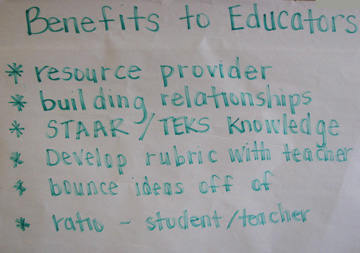
Collaborative planning is another form of job-embedded professional development. In the one-hour workshop after observing  cooperation and a collaboration planning session role play, the preservice principals in the TWU Professional Development and Supervision course identified the items (on the post-it pictured) as benefits to educators.

While this confirms to me that these practicing classroom teachers value the school librarian’s expertise as a resource provider, I noticed that building relationships appears on this group’s list as well as on the benefits-to-principals list. I believe that school leaders are more and more aware of the importance of nurturing a positive school climate. Educators who support the principal in that effort, school librarians included, are especially valuable members of the learning community.

STAAR (Texas standardized achievement test) and TEKS (Texas state standards) were third on their list. Of course, school librarians and classroom teachers with deep knowledge of curriculum and how it’s tested are important to these preservice principals. Administrators feel the pressure for addressing standards and improving test scores. They could see in the role play that an interdisciplinary approach allowed the educators to cover more ground while students experienced deeper learning experiences.

Win. Win. Win.

As instructional partners, the work of school librarians is integrated into the academic program of the school, increasing their potential to affect student achievement significantly. However, when school librarians are asked whom they serve “most would answer students, yet the primary clientele in terms of power, impact, and effect would be teachers” (Haycock, 2010, p. 3).

If you are a school librarian, if asked, what would your classroom teacher colleagues say is your greatest contribution to the learning community in your school and how do teachers benefit from coplanning and coteaching with you?

Reference

Haycock, K. (2010). Leadership from the middle: Building influence for change. In S. Coatney (Ed.), The many faces of school library leadership (pp. 1-12). Santa Barbara, CA: Libraries Unlimited.

Job-embedded Professional Development

Job-embedded Professional Development: That’s what preservice school principals have been taking away from presentations I have been making at a preservice Professional Development and Supervision course. Thanks to my TWU educational leadership colleague Dr. Teresa Starrett I have had three opportunities in three different semesters to talk with three different classes of principal candidates.

In the one-hour workshop, we look at research and standards and most importantly of all, we demonstrate the potential impact of classroom-library collaboration for instruction on students’ learning outcomes and educators’ teaching.

Serving in the role of school librarian, I model cooperation and contrast it with a collaborative coplanning session with a classroom teacher. On November 5th, one of the preservice principals role-played a middle school social studies teacher. While we cooperated and collaborated, the class made notes about the benefits to students, educators, or principals. This week, I will post the results for each of these library stakeholders.

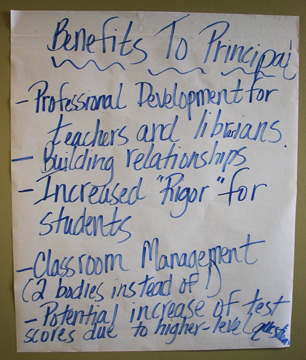
The photo above shows the “benefits to principals” identified by one group. All three times I have offered this workshop, preservice principals have noted “job-embedded professional development” as the number one benefit to principals. Yes, they are in a course in which this aspect of their future jobs is being stressed, but this also shows me that principals are seeking support in this area. To know they have someone in the library who is working closely with all the teachers in the building to improve instructional practices is a godsend.

They are also aware of the importance of building relationships in order to develop a positive school climate. (And I hope they have the goal of building a culture of collaboration in mind as well.)

If you are a school librarian, if asked, what would your principal say is your greatest contribution to the learning community in your school and how does your principal benefit from your work?

PLNs=Connections=Collaboration=Happy Teacher Librarians

Once again, I am always amazed at coincidences that happen from day to day.  In the final module for the professional development course I am facilitating this semester at UVM, we are focusing on literacy leadership and advocacy.  Part of the required reading and discussion has centered on developing PLNs for professional practice.  For teacher librarians in the field, PLNs are critical for keeping current and for communication and collaboration, and they also provide opportunities for advocacy.

Personal Learning Networks are lifelines for staying connected in this wild Web 2.0 world.  Establishing a PLN enhances professional development, lifelong learning, and opportunities for collaboration, locally, nationally, and globally.  It’s especially important for those of us in the profession who are sole practitioners in a building, or even serving multiple schools in a whole district. A PLN has potential as a support system for anyone who wants to reach out and converse and collaborate with other folks who have similar interests and challenges, and may have different views to share.

Getting back to the coincidence I mentioned, as I was polishing off the module and preparing to post it to the Blackboard site, the mailman delivered the November/December 2012 issue of Knowledge Quest. To my very pleasant surprise, the theme for the issue was “Personal Learning Networks.”  I quickly added it as a resource for the module, and what a resource it is!

Not only does the print issue offer a range of articles that cover a variety of possible advantages of using PLNs in professional practice, but the links on the AASL website provide lots of other resources to explore.  If you are a member of AASL (another reason to join), you have access to the print and online editions of the publication, support materials, webinars, and social networking sites.  If you don’t belong, you can still have access to many of the resources online.

To get started here are some recommended highlights from the Knowledge Quest website: http://www.ala.org/aasl/aaslpubsandjournals/knowledgequest/archive/v41no2

  • Table of Contents: Check out the awesome articles in the print edition. There is a direct link for AASL members for the online edition, or if you have access to online databases through your school or public library, you can find KQ articles indexed in several of them.  They are a gold mine.
  • KQ Webinar-coming soon: “Making the Most of Professional Learning Communities” Tuesday December 12, 2012 at 7:00 PM EST.
  • 30 Second Thought Leadership: Jennifer LaGarde and Liza Perez. “What makes personal learning networks critical for professional development?”

And coincidentally, if you have not jumped in and set up a site for curating your favorite websites, blogs, nings, twitter and rss feeds, and so on, as Jennifer LaGarde says, “What are you waiting for?”


Resources:

“Personal Learning Networks”, American Library Association, November 14, 2012. http://www.ala.org/aasl/aaslpubsandjournals/knowledgequest/archive/v41no2 (Accessed November 25, 2012)

“30 Second Thought Leadership”, American Library Association, February 21, 2012. http://www.ala.org/aasl/aaslpubsandjournals/knowledgequest/aboutkq/30second (Accessed November 25, 2012)


Notes from AASL Fall Forum


By reviewing the readings and joining the Ning, I felt pretty prepared to attend the AASL Fall Forum 2012 on Transliteracy, in Greenville, South Carolina.  While I was excited about aspects of participatory culture, I had real concerns about the print centric emphasis of the Common Core Standards, so I was especially interested in learning about how other educators were integrating cross media platforms as vehicles for learning.

The presenters, Henry Jenkins, Kristin Fontichiaro, and Barbara Jansen provided a whirlwind tour of the intersection of informal and formal learning through the possibilities and challenges of school environments.  Throughout the intensive sessions, various models of collaboration were evident.

Henry, Kristin, and Barbara modeled a constant organic collaboration, as they shared, explored, and extended each others’ work and ideas.  Instead of three separate tracks, they were able to integrate and connect ideas through conversations with each other and with the participants to present a holistic view of transmedia and learning.  Henry’s closing remarks were inspiring as he made connections to the democratic power of social media.

Collaboration across time and space took place in several satellite sites.  Folks in Pennsylvania, Texas, and California, were connected through a live video conference feed during the sessions.  Participants at those sites could ask questions that were relayed to the presenters who then responded to all.  The time difference with California, meant that the site tuned in a bit later on Saturday, but they had access to the information presented through social media networking.

During the sessions, each presenter encouraged discussion by asking probing questions, and allowing time for groups at all the sites to explore and reflect on ideas.   Using Google docs, Today’s Meet, and the Ning, participants collaborated and shared conversations electronically.  Those links are available are available through the Ning that is open to all who are interested.

My brain was on overload for two days, as the presenters and participants demonstrated multiple paths for thinking about teaching and learning.  It was great to network with folks from other states who shared their successes and frustrations that sounded a lot like my own experiences.  One woman who was in an elementary school in Georgia had 750 students in her school. Fortunately, she had flex time and a clerk.   Another participant from Maine supervised paraprofessionals in several schools in a district.  Some who worked in private schools were unencumbered with constraints in public schools- lots to think and talk about. The Common Core was a major buzz everywhere.

One of the participants, Linda Dougherty, created a Pinterest Board of links that were tweeted during the conference.  Things went so fast, I could not keep up, so it might give you a flavor of what was covered. Have a look! Jennifer Tazerouti also shared lots of links in her Auntie Librarian Blog.

My takeaways:

Henry Jenkins, and the research and work that he does at USC and the Innovative Lab, informed us of the endless possibilities of connecting youth with media in informal learning.  He showed many examples of the PLAY projects that connect popular culture to learning. Given the opportunities to analyze traditional literature such as Moby Dick through a meaningful cultural lens, incarcerated youth revealed understandings and interpretations about the overarching themes in Melville’s work.  They were able to relate and produce performances that were powerful and insightful, but reflected in their own gang culture.  I have a greater appreciation about how twitter, youtube, and other social media can drive ideas and movements very quickly through the world. Jenkins feels that libraries are important incubators for advancing the democratization of learning.  He cited the public library in Chicago for its programs for youth after school.  Another project that is in the works will be of interest to school librarians.  He is working with author/illustrator David Wiesner to create a transmedia production for Flotsam (2006), with interactive components, links to oceanographic studies, and other creative options for sharing the book through multiple lenses.  I was thinking that would be great to connect it with an information text such as Loree Burn’s, Tracking Trash: Flotsam, Jetsam, and the Science of Ocean Motion. (2007)

Kristin Fonticihiaro, who has unlimited energy and in depth understanding of the pedagogy of learning, gave us some background on the emergence of the term transliteracy.  She asked us to think about how this concept is different from what we have been doing all along.   The digital networked environment has changed that way that people read and interact with information, and we need to think about effective ways to integrate this understanding into how and what we teach in the context of  the text oriented environment of the Common Core Standards.  Kristin presented the contrast between informal learning as described by Henry Jenkins, and what happens in schools, where there are barriers to access to the internet, as well as, curriculum guidelines and high stakes tests.

She also focused on assessment, instructional design, and expectations for effective student work in learning with technology.   She shared examples of students’ work to look for evidence of learning.  Take a look at the videos and see if you can tell what the students have really learned (synthesized), and also what value the format of the report adds to the learning.

Barbara Jansen, School Librarian and author from Austin, Texas, filled in at the last minute for another speaker who could not make it.  She was a treasure trove of ideas and examples for designing lessons and units that incorporated authentic challenges for students.  Here is a link to the wiki that she set up for her speech, and also her virtual library.  Look at the integrated assignments page, and the menu for pages that define and clarify research strategies-a model for all to take away.

Thank you to all involved in putting together a rewarding and informational experience. Barbara Jansen, coincidentally was the chairperson of the committee that organized this event, and special hats off to her for her excellent and seamless contributions to the conference at a moment’s notice.

As a participant, I came away with the feeling that there is still so much to learn about bridging the participatory gap for all our students.  The folks at this conference seem have a handle on it, but as school librarians in practice, the only way we will make a difference is to be part of the conversation in our own district and school communities-think leading from the middle through collaboration.  We have to have to share ideas that we learn from others who are traveling the same path, so let’s get going!

Nuff said!

Some resources mentioned above:

Burns, Loree. (2007).  Tracking trash: flotsam, jetsam and the science of ocean motion. Boston: Houghton Mifflin.

Jenkins, Henry et al. (2006). Confronting the challenges of participatory culture: media education for the 21st Century. Chicago: MacArthur Foundation (white paper).

Wiesner, David. (2006). Flotsam. Boston: Clarion Books.


Library 2.012 Conference – Free, Online Professional Development Opportunity

The Library 2.012 Conference, a free virtual professional development opportunity, will be held this week from today October 3rd through Friday, October 5th. Check it out at: http://www.library20.com/page/2-012-conference

Many school librarians are involved in presenting sessions. So check out the schedule in your time zone.

On Thursday at 7:00 p.m. Central Time, TWU doctoral student Ruth Nicole Hall and I will be presenting a session.

Telling Your Advocacy Story with Digital Tools
In this session, we will discuss the importance of harnessing the power of software and Web 2.0 tools to reach school library stakeholders to make a case for the central role of school librarians is creating vibrant literacy learning communities in their schools. Using digital stories to deliver advocacy messages is an effective and efficient way to reach out to classroom teachers, school administrators, K-12 students, and their families.

We will share several examples and will use a digital advocacy story focused on coteaching and targeted to classroom teachers and principals as our primary example.

We hope many Building a Culture of Collaboration Blog readers will attend the conference.

See you online!

Flipping Collaboration for Professional Development

For this week, I’d like to offer some thoughts about Sue Kimmel’s challenge for flipping collaboration (post 9/9/12) in a different, but related model for professional development by and for teacher librarians.

“I would like to advocate that we look for ways to become more fluid and nimble in our approach to time and how we use it to co-plan, co-implement, and co-assess teaching and learning as we continue to ‘push everyone toward excellence (Loertscher, 2008)’.”

One of the guidelines in Empowering Learners (2009), concerns professional development designed to “sustain and increase knowledge and skills.” (43)  As teacher librarians, we strive to expand our understanding of best practice through various opportunities for professional development through courses, webinars, conferences, and so on.  In our schools, we provide learning experiences for our colleagues, as well as our students.

The time issue looms large for both participating in and providing for professional development.  Other than dedicated professional development days that are scheduled around administrative goals, there just aren’t enough hours in the school day for sustained, reflective, meaningful learning for any of us. How can we find a better way that will make a difference?

Web 2.0 tools and applications offer platforms for co-teaching and learning for students, as Sue mentioned, but let’s think about how we might use a 24/7 environment for providing a community space for teacher learning.  The purpose could be described as a place to read and reflect, take risks, model new technology applications, ask questions, discuss and debate, collaborate, and develop new resources for practice and personal learning networks.

Sounds like pie in the sky, but let’s take a look at Jennifer LaGarde’s blog (Adventures of Library Girl) as she describes how she uses Edmoto as platform for “Gamifying PD.”  When you look at the list of expectations and goals, you will see that she has combined face to face, online, and participatory activities-and it sounds engaging and fun.  And it’s available 24/7 whenever a participant logs on.

Blended learning is another way to describe participatory interaction that offers opportunities for face to face and online learning that are both individual and interactive.  A course/learning management system such as Blackboard, Moodle, Haiku and others, can provide a space for content, assessments, discussion boards, blogs and so on, that is available asynchronously.  Face to face sessions can be physical or virtual through webcasts or podcasts, both synchronously and asynchronously.

If you are interested in how blended learning works as a model for higher education, I recommend reading “Communities of Practice for Blended Learning: Toward an Integrated Model for LIS education.” (2010) I discovered this article when I was doing research for a chapter in a book about blended learning.  Joyce Yukawa of St. Catherine University in St. Paul describes blended learning within a graduate level LIS course.  She provides the rationale for combining appropriate technology to meet the needs of adult learners and to foster a social construct for learning. The emphasis is on learning by doing.  LIS students had to use the technology applications as they focused on library projects and assignments. The ideas presented here provide convincing reasons to think about ways to adapt school or district wide professional development to a blended learning environment.

At UVM, where I teach and learn from my students, blended learning has enhanced a cohort experience for everyone.  In school library media studies courses, students from across the state are able to participate in courses for licensure or professional development. In a small state such as ours, we are proud to have contributed to building a network of colleagues and friends who have become educational leaders in schools across Vermont, and access to 24/7 online learning has paved the way.

Collaboration is at the crux of participatory culture.  So let’s get on with it!

Judy Kaplan

Resources

American Association of School Librarians (AASL). (2009). Empowering learners: Guidelines for school library media programs. Chicago, IL: American Library Association


LaGarde, J. (2012, August 12). Game based PD for an epic win [Blog post]. Retrieved from http://www.librarygirl.net/ 2012/08/game-based-pd-for-epic-win.html


Yukawa, J. (2010). Communities of practice for blended learning: toward an integrated model for LIS education. Journal of Education for Library and Information Science, 51: (2) 54-75.